Once Upon a Time… in WANA
 Facebook
 Twitter
 Linkedin
 Google +
China’s growing positive role and the hope it offers the majority disadvantaged by the Western-dominated global system demand China’s perspective in reshaping a better world.
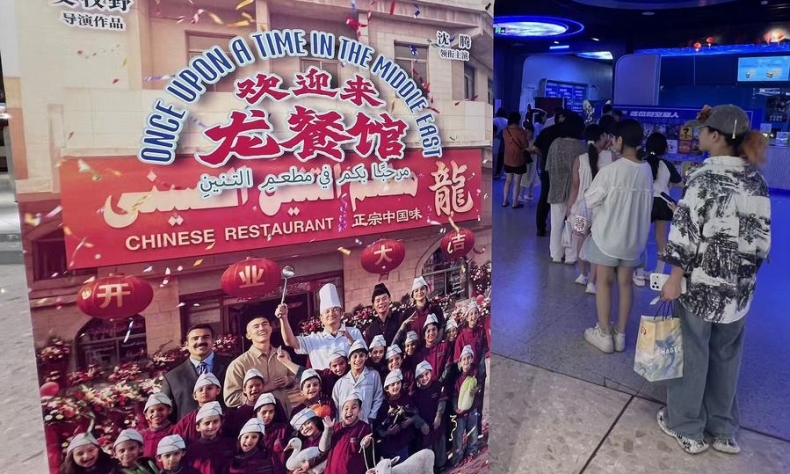
Set mostly in a small Chinese restaurant in war-torn Iraq in 2003, the recently released Chinese film Once Upon a Time in the Middle East has become the domestic box office smash of this summer.
But for us audiences from West Asia and North Africa (WANA), regions that have lived through the wars depicted in the film, the story it tells provokes numerous reflections.
To interpret this film, one must first understand how stories, ideologies and hegemony function as forms of power.
Capitalism and modernity brought new forms of power unknown to pre-modern empires. Chief among them was a Eurocentric worldview that defined the world for European imperial expansion while subordinating other nations after 1492, eliminating their perspectives and stories.
With the United States becoming the globally dominant power in the post-World War II period, Eurocentrism was reshaped to grant the West, under U.S. leadership, the “right” to intervene across the Global South wherever and whenever it chooses.
China was and remains a victim of these Eurocentric representations.
The West forced China into a century of humiliation, beginning in the mid-19th century.
China is the only nation that has dragged itself from imposed imperial underdevelopment to industrial prosperity using its own model.
Yet this is not what the U.S. and five centuries of Eurocentric structure acknowledge. Sinophobia dominates. One example thereof: The U.S. House of Representatives in September 2024 passed a bill that allowed for the allocation of $1.6 billion for propaganda against China from 2023 to 2027.
This is the structure of knowledge and knowledge-making for both West Asia and China. Yet China has made remarkable achievements—one being its cinema. Once Upon a Time in the Middle East follows two Chinese nationals managing a restaurant in Iraq, surviving the fallout of the 2003 U.S. occupation.
The movie only makes sense within the context of China in 2003. China’s economic, technological and global role then is not comparable to today. According to the Carnegie Endowment for International Peace, in 2003, only 35 percent of African nations preferred China over the U.S. for trade—not because the U.S. treated them better, but because China had little to offer. By 2023, however, all African nations preferred China over the U.S. As Chinese purchasing power grows, the country’s economic strategy is shifting from China as the world’s factory to China as the world’s market. The image of Chinese labor in West Asia is also changing, from cheap labor in Dubai to higher-earning investors and technicians.
Against this backdrop, the image of a passive Chinese chef who refuses to choose between imperialism and its victims, doing business with everyone at any cost, can only be understood through the imperatives of China in 2003.
For all its high-quality direction and technique, the film shows only a superficial grasp of the U.S. invasions in WANA. Coca-Cola cans appear at least three times—yet branded Coca-Cola was scarce in Iraq under the 1991-2003 sanctions, when the United Nations’ oil-for-food program strictly limited imports to U.S.-approved humanitarian goods.
The film’s portrayal of WANA resistance is influenced by its Western counterparts. Half the movie brilliantly exposes the ugly side of the U.S. invasion of Iraq. But the other half fails to show the ugly side of what extremist groups meant for Iraq—largely because it generalizes extremists as representing the entire resistance. It is true that extremists targeted and harmed the local population. What is absent, however, is that these groups were historically created by the very American invaders depicted in the film to be deployed against adversaries: the USSR, post-Soviet Russia, Iran, Syria and even China. The diversity of resistance groups is erased; extremists stand in for all.
Ideas, ideology and hegemony have long shaped the unevenly developed world. China’s growing positive role and the hope it offers the majority disadvantaged by the Western-dominated global system demand China’s perspective in reshaping a better world. Chinese cinema must tell that story in a louder voice.
The author is an Iranian associate professor of global political economy and Western Asia politics at Beijing Foreign Studies University.