How a Beijing Trade Fair Turns Small Companies into Global Exporters
 Facebook
 Twitter
 Linkedin
 Google +
The fair has already shown what it can produce: companies with specialized, hard-to-market services landing buyers in countries they’d never reached before.
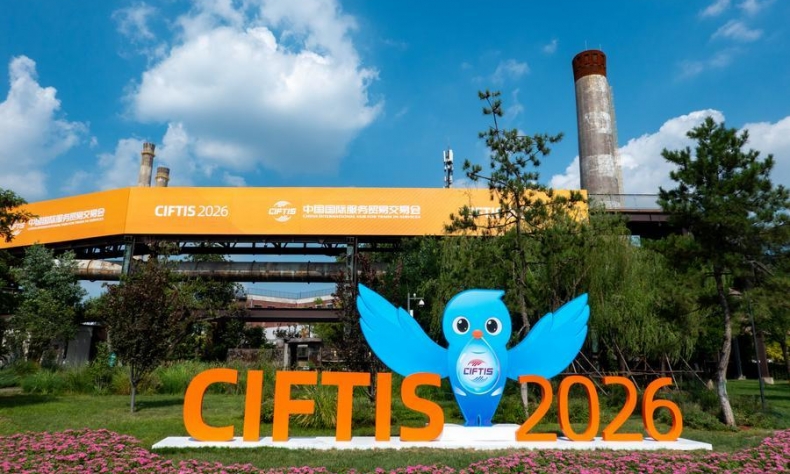
The China International Fair for Trade in Services, known as CIFTIS, runs September 9 to 13 at Shougang Park in Beijing, a former steel mill turned into one of the city’s main exhibition venues.
Now in its thirteenth year, CIFTIS gives Chinese service providers, from insurance firms to sports technology developers, a place to show what their product actually does. It then connects them with international buyers through organized matchmaking instead of leaving them to find distributors on their own. This year’s edition has drawn roughly 90 countries and international organizations and more than 1,800 exhibitors, with Norway as guest country of honor and Guangxi as guest province of honor.
What makes CIFTIS matter beyond its size is what it produces once the booths come down. Companies with a niche or highly specialized service, the kind that’s hard to sell without a live audience to demonstrate it, use the fair to reach international buyers they’d otherwise have no way of finding.
How small companies turn booths into buyers
A Beijing sports technology company called RigourTech offers one example of how that works in practice. It’s a medium-sized firm, where researchers make up nearly 80 percent of the staff. Its AI-powered tracking system, China Hawk-Eye, follows the position of a ball or multiple players on a field in real time and feeds instant replays and precise data to referees and broadcasters. The technology helps power everything from video assistant referee (VAR) calls in football to virtual offside lines and instant replay in table tennis, tennis, and volleyball. The system is already in use at events including the AFC U20 Asian Cup, exposure that has led youth training clubs abroad to contact the company directly. After connecting with buyers at CIFTIS, RigourTech is now exporting that system to South America and Southeast Asia, reaching clients it likely couldn’t have found on its own.
RigourTech isn’t the only company organizers point to. At a briefing on past editions of the fair, officials described a cultural tourism company that used CIFTIS to find more than 120 filming locations along Beijing’s stretch of the Grand Canal, turning on-the-floor conversations into licensing deals with film and TV production companies.
CIFTIS organizers have added new tools this year to make that kind of outcome more common. A new “Going Global Service Promotion Roadshow Zone” is meant to help smaller Chinese companies pitch directly to international buyers, and an AI matchmaking platform now automatically pairs exhibitors with buyers who fit their product, rather than leaving companies to network and hope for a good match. A separate “China Service” zone was also added this year to highlight domestic achievements in services trade, and several sections of the fair now have their own “Global Service” areas to help exhibitors take their first steps into overseas markets.
Why services trade deserves more attention
When people talk about Chinese trade, they usually mean physical goods: electric vehicles, batteries, electronics, and machinery. Services trade gets far less attention, partly because it doesn’t move through a port and can’t be photographed on a cargo ship. But the numbers suggest that China’s services trade reached about 3.78 trillion yuan ($556 billion) in the first half of 2026, and knowledge-based services made up 44 percent of all services trade during that time.
Those numbers point to a real change in what China sells to the world, not just growth in the same old categories. Officials at China’s Ministry of Commerce describe this as a shift away from labor-intensive services and toward those built on know-how and technology, including everything from patent licensing to dedicated software. The difference matters: shipping a manufactured product represents the work of a large factory with many employees. A licensing deal for specialized software, by contrast, reflects the work of a company that may employ only a few hundred people. As a result, growth in services exports often helps smaller, more specialized companies, not only the big industrial exporters that dominate manufacturing headlines.
This also changes which kinds of companies stand to benefit most from China’s trade growth going forward. A factory that wants to sell more electric vehicles overseas needs years of construction and heavy investment to expand. A software company or a tourism firm licensing its expertise can grow much faster, because what they’re selling is know-how rather than a physical product. That’s a big part of why the government has called knowledge-based services a priority for the current five-year plan.
What happens after the fair ends
CIFTIS organizers have started tracking what they call “implementation stories,” cases where a company’s time at the fair led to an actual signed contract. Officials point to deals like the ones described above as exactly that kind of proof, evidence that the fair has moved from short-term attention to lasting business relationships. Close to 90 countries and nearly 1,800 companies are expected to take part this year, giving even more companies a shot at reaching international buyers.
Once the exhibition halls at Shougang Park close for the year, that scale will pay off. The fair has already shown what it can produce: companies with specialized, hard-to-market services landing buyers in countries they’d never reached before. With more countries, more exhibitors, and better matchmaking tools in place than in past years, this edition of CIFTIS is positioned to send even more companies down that same path. A week of conversations in Beijing could turn into contracts that carry Chinese services further into new markets in the months ahead.