Does the G7 Still Make Sense?
 Facebook
 Twitter
 Linkedin
 Google +

Can a grouping that struggles to maintain consensus among its own members still claim to provide effective leadership on increasingly complex global issues?
From June 15 to 17, leaders of the Group of Seven (G7) gathered in Évian-les-Bains, France, for their 52nd summit. On the agenda were issues such as global economic rebalancing, critical mineral supply chains, the competitiveness of new-energy industries and AI—all areas in which China plays an important role.
Even before the summit began, an Associated Press article posed a poignant question: “Without China, does the G7 make sense?” The report argued that China has become the most obvious “elephant in the room” at G7 gatherings. Given China’s growing economic, political and technological influence, discussing many of today’s global challenges without its participation increasingly appears out of step with reality.
Since its inception in the 1970s, the G7 has been a mechanism led by advanced Western economies and has carried the imprint of a small group seeking to shape the global order. At the time, the combined economic output of the United States, Britain, France, Germany, Japan, Italy and Canada accounted for more than 60 percent of the global economy. Back then, a three-day meeting behind closed doors was enough to influence the direction of the world economy.
But since then, the global economic landscape has changed dramatically. The G7’s share of global GDP has fallen from a peak of 65.9 percent to around 44 percent, while the combined economic output of the BRICS countries, measured by purchasing power parity, has already surpassed that of the G7.
China has been one of the largest contributors to global economic growth for many years. It is the world’s largest manufacturing center and trading nation. China also plays a dominant role in the processing and refining of critical minerals such as rare earths, lithium and cobalt. In cutting-edge technologies such as new-energy vehicles, solar power, 5G and AI, China is now firmly among the world’s leading innovators.
The shifting balance of economic power is only part of the story. More fundamentally, the logic of global governance itself has changed. The old model, in which a handful of wealthy countries set the agenda and the rest of the world followed, no longer fits the reality of an increasingly multipolar world.
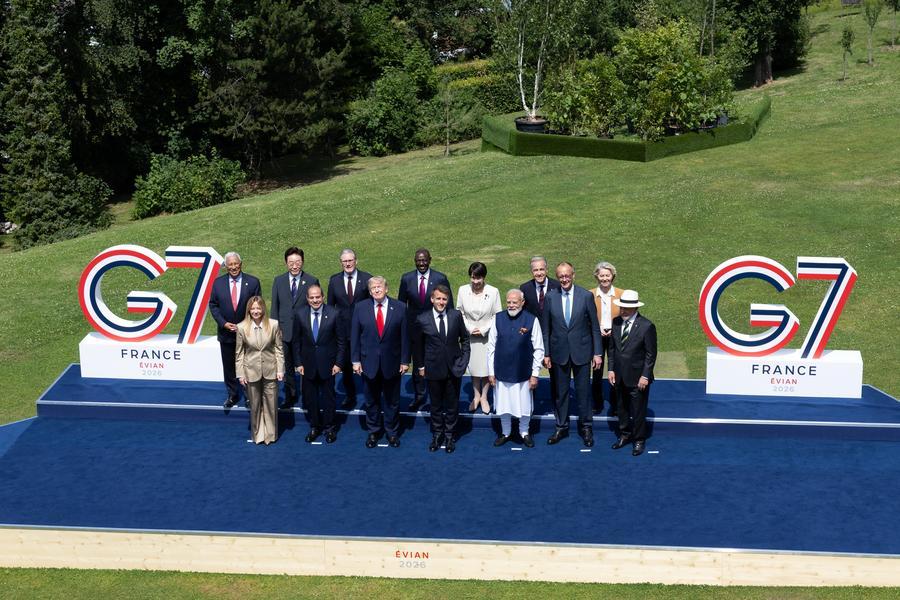
The agenda of this year’s G7 summit illustrates the problem. Although leaders from Brazil, India, Ukraine and other countries and international organizations were invited to attend, discussions on global economic rebalancing cannot avoid China, the world’s largest trading nation. Discussions on critical mineral supply chains cannot avoid China, which dominates the processing of rare earths and other key minerals. Discussions on AI governance cannot avoid one of the world’s largest AI markets.
Some G7 members appear aware of the limitations they face. In late 2025, French President Emmanuel Macron reportedly raised the idea of inviting China to participate in the 2026 G7 Summit. Yet the idea never gained consensus within the group.
Ideological boundaries and growing internal divisions are G7’s internal weaknesses.
The G7 has always been more than an economic coordination mechanism. It is also a political grouping built around a shared understanding of liberal democratic values. During the Cold War, this common identity helped provide cohesion. Today, however, it increasingly limits the group’s ability to adapt to a changing world.
An unwritten principle has long guided the G7: Membership is reserved for countries that meet its definition of “liberal democracies.” For this reason, China has never been considered a candidate for inclusion. Yet when the world’s second largest economy, largest trading nation and largest manufacturing country remains outside the room, questions naturally arise about how representative the mechanism can be in addressing global challenges.
China has consistently argued that international affairs should be discussed through broader participation rather than exclusive clubs, and that countries with different political systems and development paths should all have a voice in addressing common challenges. From this perspective, even if the G7 were to open its doors to China, its small-group approach to global governance would still differ fundamentally from the more inclusive framework China advocates.
At the same time, divisions within the G7 itself have become increasingly difficult to conceal. Differences between the United States and Europe have widened on trade, defense and security issues. President Donald Trump has threatened steep tariffs against European exports while pressing NATO allies to raise defense spending to 5 percent of GDP. On Ukraine, many European governments favor sustained military support, whereas Washington has placed greater emphasis on ceasefire negotiations.
These disagreements do raise a larger question: Can a grouping that struggles to maintain consensus among its own members still claim to provide effective leadership on increasingly complex global issues?