Why the Classics Still Matter – and Why Now
 Facebook
 Twitter
 Linkedin
 Google +
In an era marked by casual historical revisionism, shallow cultural relativism, and unwarranted attacks on established facts, about antiquity as much as about the modern era, it is essential to safeguard the proper historical dimension and cultural meaning of the classical world.
Classical wisdom remains an essential source of inspiration for our world and a resource for thinking through contemporary global challenges. It does so not only by providing seminal texts that seeded our cultural and scientific traditions, but also by modeling forms of agency, dialogue, and cooperation that reach across borders. The classical world – Greek, Latin, and Chinese – helps us shift our governing paradigms away from short-termism to a macro-historical perspective: one that embraces the rich heritage of thousands of years and the enduring values of order, culture, and historical continuity.
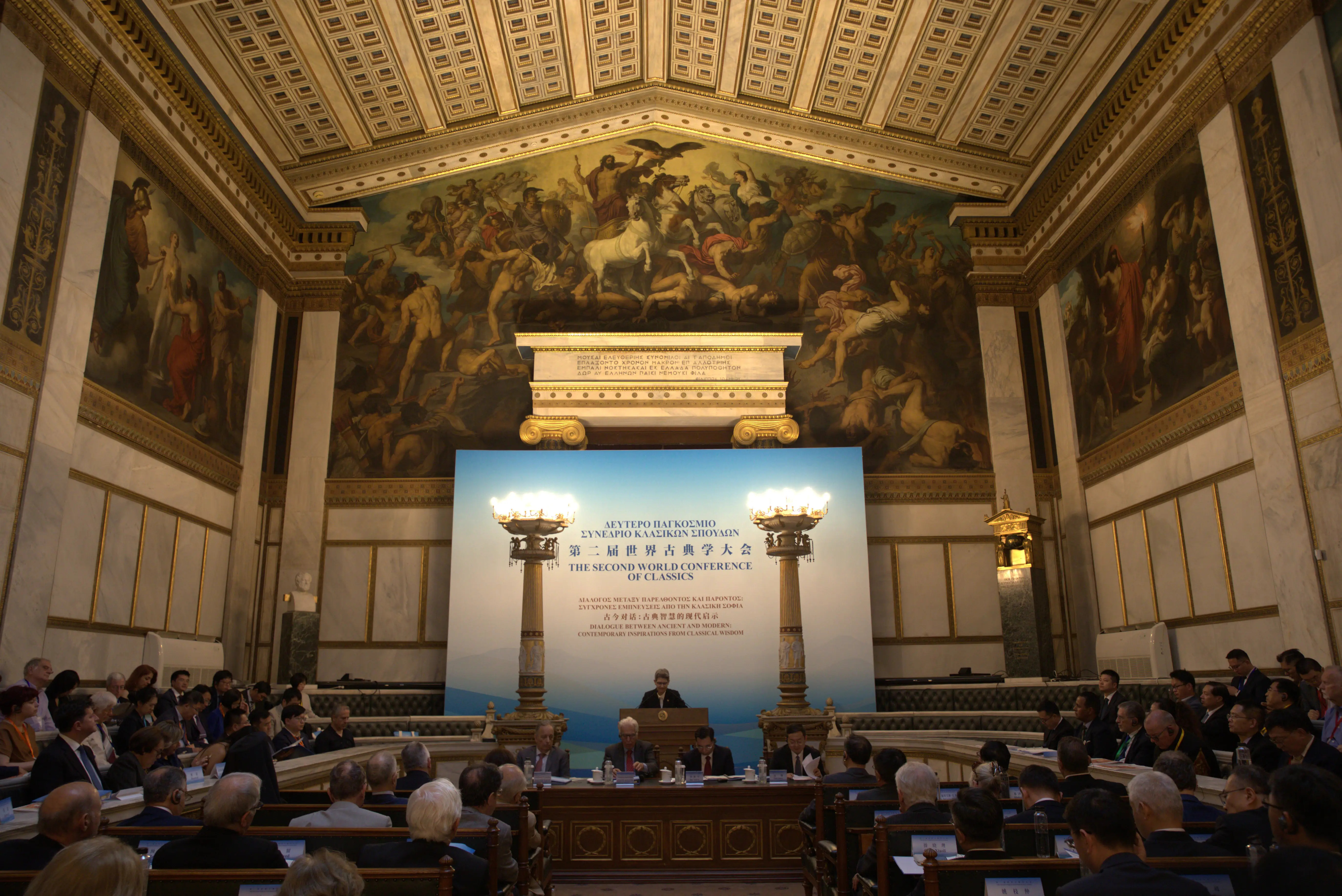
The Second World Conference of Classics held in Greece is a landmark event in the study of ancient heritage and its importance for our modern world. The conference with the theme “Dialogue between Ancient and Modern: Contemporary Inspirations from Classical Wisdom,” brings together leading scholars in classical studies, history, and archaeology from China, Greece, and many other countries. The conference is jointly organized by the Chinese Academy of Social Sciences (CASS), China’s Ministry of Education, China’s Ministry of Culture and Tourism, Greece’s Ministry of Culture and the Academy of Athens. In four parallel subforums, the conference will address key issues related to academic enquiries and modern societal needs, such as classical education, ethical community, international order, technology and humanism in the digital era.
What then, is the relevance of classical studies in today’s world? In what ways does the ancient heritage influence and define us today? How can we enhance our understanding of the ancient world and the current era through the timeless lens of classics and move towards the principles of collective responsibility, mutual respect and shared future? These are all fundamental questions that Western and Eastern perceptions of the ancient world can help us to illuminate.
Classic texts echo our shared humanity
One of the most interesting aspects in the relevance of classical tradition is its contribution to how we perceive and navigate the modern geopolitical landscape. War and peace, order and liberty, and the dynamic interaction of civilizations and polities – all of these can be approached afresh when we adopt a long-term outlook. The classical world does not offer quick fixes; but it does supply something more rare: a civilizational vocabulary for grasping complexity, especially in an era of intense polarization. Ancient reflections on statecraft and international order can help us move beyond the fatalistic model of inescapable strife and hegemonic competition, toward a vision of shared security – one grounded in the timeless principles of coexistence, sovereignty and rightly ordered patriotism.
Herodotus, father of Western historiography, recorded the clash of empires and the dynamic interaction of civilizations across Eurasia, documenting an age of unprecedented change across borders and peoples. Herodotus offers the first Western sustained inquiry into the geography, cultures, and political worlds of Asia, and into the constructive possibilities of cultural contact, not merely collision. In his magisterial History of the Peloponnesian War – a narrative of the demise of the classical Greek world – Thucydides, the great realist thinker, crystallizes the causal factors of conflict into three elemental aspects: fear, interest, and honor. These concepts still resonate with modern realist theories of international relations and interpretations of wars. The triad of ancient Greek philosophers, Socrates, Plato and Aristotle, created the basis of concepts and ideas of all Western philosophy for centuries to come. Their political aim was restorative, not abstract: to rebuild the conditions of civilizational order after civil war and the erosion of national unity.
On the Chinese side, the notion of tianxia (天下, all under Heaven) highlights the importance of collective cooperation for achieving security and political order, presenting early forms of modern multilateralism and international cooperation. The intellectual traditions of Confucianism, Legalism, Taoism, and Mohism created unsurpassed models of moral guidance, societal cohesion and cultural resilience. These schools often sought stability in an age of turmoil and upheaval, producing erudite works of great refinement and intellectual depth. With its multilevel connotations, the Confucian concept of li (礼 – rites, propriety, norms) and the Greek nomos (νόμος – law, custom) resonate across languages: both encode the idea that culture is not decoration but the infrastructural fabric of peace. Sima Qian, famed historian of the Han Dynasty (202 BC-220) and father of Chinese historiography, reminds us that civilizational orders must be narrated to be sustained, and that peaceful integration is always a harder, and higher, achievement than conquest. Thus, classical thought from Greece to China is not an isolated endeavor, but rather a shared, fertile legacy of immense depth that resonates with modern societal needs and offers useful models of understanding and practice.
Safeguarding historical tradition
The Western classical canon, rooted in the Greek and Latin corpus, and China’s classical traditions (国学, guoxue) converge in having vigorously pursued, across very different idioms, the same triad: social justice, political order, philosophical truth, and civilizational continuity. Western and Chinese classical traditions have to be examined not just in their distinct historical trajectories, as products of national cultures, but also in their commonalities and meeting points, as shared patterns of cultural creativity across Eurasia. In this sense, the classical tradition serves both as the origin of national identity and as the bridge between the East and the West.
In an era marked by casual historical revisionism, shallow cultural relativism, and unwarranted attacks on established facts, about antiquity as much as about the modern era, it is essential to safeguard the proper historical dimension and cultural meaning of the classical world. The classical tradition was built on values of dynamism, social harmony, historical self-knowledge, and cultural continuity. Ancient Greek, Roman, and Chinese thinkers aimed to stabilize the political order and safeguard the cultural heritage, not to undermine or distort it. The uneven decay of classical studies in parts of the West has, unfortunately, facilitated historical distortion and weakened the ties binding societies to their collective cultural past. Reviving the serious study of classics remains an intellectual and civic priority, and international cooperation, of which the World Conference of Classics is a flagship example, is the most promising way to do it.
Why and how then do the classics still matter to our fast-moving societies? In terms of intercultural contact, the classics make visible the shared patterns of thought, aspirations, and cultural elements between China and Europe over thousands of years. From the parallel philosophical awakenings across Eurasia during the so-called Axial Age (8th-3rd c. BC), through Greco-Roman contact zones and Silk Road transmissions, down to early modern travel accounts and today’s advanced scholarship, the classical tradition supplies the cognitive footing for mutual respect between China and Europe – and in many ways underpins the deeper layers of modern China-European relations.
Yet classical tradition is not just a factor in intercultural dialogue and mutual understanding; it is equally an anchor of national identity, sustaining social cohesion, cultural continuity, and historical memory. These principles find their most memorable expression in the two foundational epics of the Western world, the ancient Greek Iliad and Odyssey by Homer. In the Iliad, Hector, defending his native city Troy, is faced with foreboding omens of defeat. His reply still echoes through the centuries as a testament to moral responsibility and political duty: “There is only one good omen/to fight for your fatherland.” In the Odyssey, namesake hero Odysseus returning from the war of Troy “saw the cities of many men and learned their mind” in the words of ancient poet Homer. Odysseus wanders the ancient world navigating between unknown societies, modes of political order and cultural customs. The end of his journey is marked by his return to the familiar landscape of his fatherland and the cultural milieu of his nation. In the end, the classical tradition allows West and East to promote mutual understanding between civilizations and to navigate the international landscape safely anchored in our national heritage, forging new paths forward without severing the link that binds us to the past.
Ioannis E. Kotoulas is adjunct lecturer in history and geopolitics at the University of Athens and co-chair of the Modern Greek Studies Program of Southwest University (Chongqing).