The Electric Wave
 Facebook
 Twitter
 Linkedin
 Google +
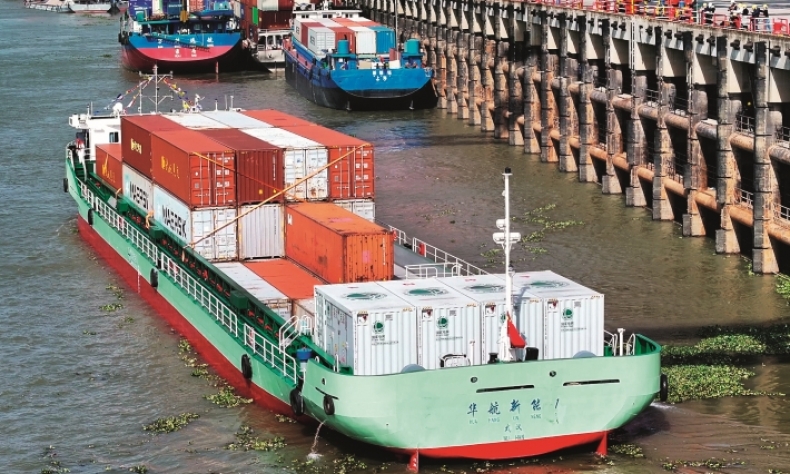
Battery-powered vessels and smart systems are directing China’s rivers towards a sustainable future.
Each morning at Yangluo Port in Wuhan, Hubei Province, the all-electric cargo vessel Huahang Xinneng No.1 completes a battery swap in under 10 minutes before returning to service with nearly 8,000 kWh of power onboard.
Assigned to a regular 100-km route between Huanggang and Wuhan, the ship has already travelled almost 100,000 km in two years, saving 132 tonnes of fuel and cutting carbon dioxide emissions by 334 tonnes annually. Its success has prompted the commissioning of six identical vessels on the same route.
Across China, provinces and cities are leveraging their strengths in river transport and technological innovation to advance a full industrial chain for green and intelligent river vessels. From research and design to construction, equipment manufacturing and operations, these initiatives are revitalising inland waterways and transforming river transport.
A silent revolution
On the Yangtze River, smoke-free, low-noise vessels are now a reality. Able to carry up to tens of thousands of tonnes without diesel, they rely on rapid, standardised battery exchange systems. At the dock, depleted batteries are offloaded to dedicated charging stations, while fully charged units are swiftly installed onboard, drastically reducing turnaround times.
Technological innovation underpins this transformation. In October 2025, the Gezhouba, the world’s first fully electric 10,000-tonne river bulk carrier, was launched in Yichang, Hubei Province. Its integrated electric propulsion system, developed by Donghu Laboratory, reflects several years of research that began in 2021. More than a dozen similar systems have since been deployed on vessels with capacity ranging from 2,000 to 10,000 tonnes.
Beyond environmental benefits, electric ships excel in intelligence. Electrification enables automated control and digital management systems, while data platforms continuously collect information from ship and shore, supporting remote monitoring, fault detection and predictive maintenance.
Building a green industrial chain
In Shandong, five multi-purpose electric ships jointly developed by CATL and Jining Energy Development Group entered service at the end of 2025 on the Beijing-Hangzhou Grand Canal. Using a “ship-battery separation” model, these 2,000-tonne vessels operate with zero emissions and low noise, cutting carbon dioxide emissions by more than 1,300 tonnes annually. CATL, involved in electric ship R&D since 2017, now equips around 900 vessels worldwide, accounting for nearly 40 percent of the global market.
Electric ship development is also energising the broader industrial chain, spanning batteries, motors, control systems, and charging and exchange infrastructure. In Jining, Shandong Province, a former coal port has been transformed into a 73-hectare hub for new energy vessels, forming a green industrial cluster focused on high-end shipbuilding, clean propulsion and intelligent river transport management.
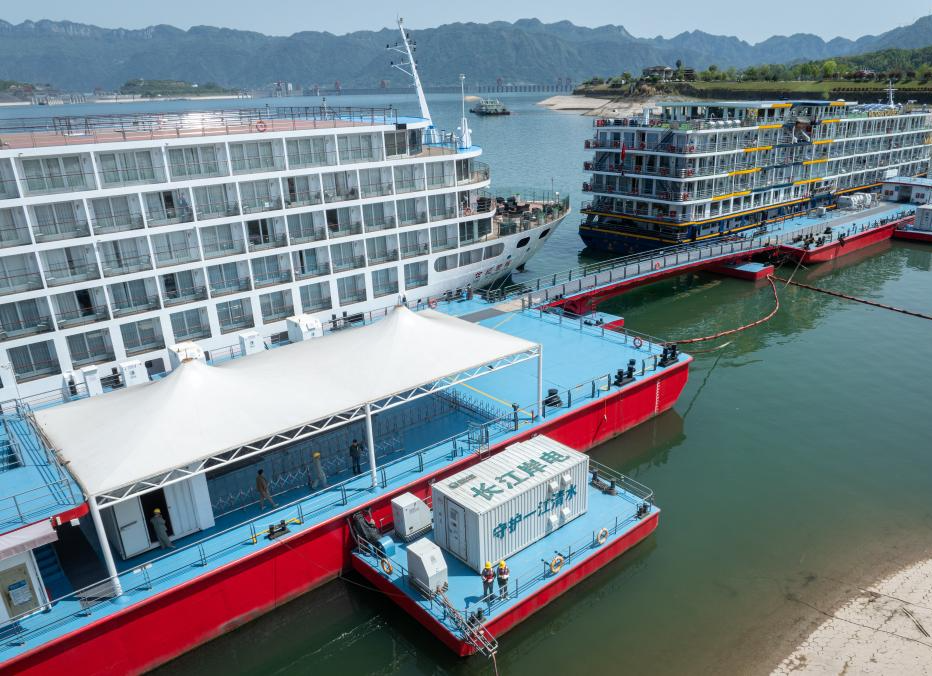
In October 2025, five charging and battery exchange stations were commissioned along a 617-km stretch of the Yangtze River. “Its efficiency is more than 20 times that of direct charging,” said Wang Xun, manager at Huadian Hubei Power Generation.
These technologies are extending beyond freight. In Wuhan, evening cruises on the electric vessel Junlyu offer a smooth, quiet experience. According to Li Mingyong, deputy director and chief engineer at China State Shipbuilding Corp.’s 712 Research Institute, the success of Junlyu inspired vessels tailored to the Pearl River, combining safety and reliability. Night cruises quickly became a cultural emblem of Guangzhou, Guangdong Province, prompting other major cities to introduce similar services.
Towards a long-term transition
China has the world’s largest inland waterway network, handling roughly 50 percent of freight transported by water. “While this mode of transport contributes significantly to the economy, it also generates considerable pollution: its carbon emissions account for nearly 3 percent of the transport sector’s total,” said Zhang Na, professor at Beijing Jiaotong University.
Under national “dual carbon” targets (peaking emissions by 2030 and achieving carbon neutrality by 2060), the shift to clean energy in river transport is accelerating. China now has over 1,000 new energy vessels. Among these, it leads the global electric vessel market, while LNG, hydrogen and methanol propulsion systems are advancing quickly. Compared with diesel, LNG vessels cut sulphur oxide emissions by 98 percent, carbon dioxide by 30 percent, and fine particulate matter by 80 percent.
Policy support is strengthening this growth. Regulations from the Ministry of Transport encourage use of electric, LNG and methanol technologies, while some provinces offer tailored standards, operational incentives and subsidies. In Shandong, new energy vessels benefit from free passage through locks on the Beijing-Hangzhou Grand Canal.
Safety remains a core priority. In February 2025, the China Maritime Safety Administration issued provisional technical regulations covering the design, construction and inspection of battery-powered vessels to mitigate fire, explosion and thermal runaway risks.
But challenges remain. New energy vessels account for only around 1 percent of the inland fleet, while nearly 300,000 diesel vessels remain in operation. Construction costs are high, with LNG vessels costing nearly 40 percent more than diesel equivalents, and vessel lifespans mean the transition will be gradual.
Globally, shipbuilding is entering a “super cycle” of green and smart transformation. The International Maritime Organisation targets of 20 percent emission cuts by 2030, 70 percent by 2040, and carbon neutrality by 2050 mirror China’s dual carbon goals.
In this context, the green and smart transition of river transport is not just an industrial imperative but a historic responsibility, set to become a permanent feature of China’s energy and logistics landscape.