The Beacon of Hope for the Global South
 Facebook
 Twitter
 Linkedin
 Google +
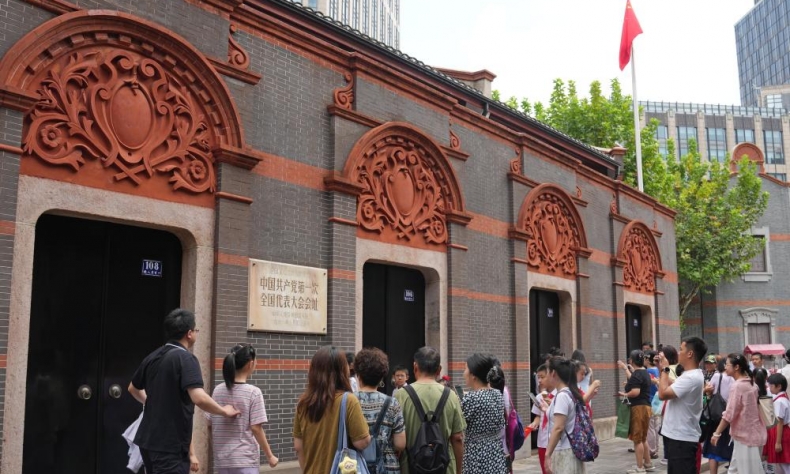
The 105th anniversary of the Chinese Communist Party celebration is not only special for the great Chinese nation, but also for the Global South, because it reminds us of the shared aspiration of each nation to forge its own path to prosperity and happiness.
There are moments in history that act as mirrors, reflecting the past while projecting the future. They bring back memories of past struggles while offering guidance on how to move forward in an age rife with uncertainties. These are special dates that reveal the future trajectory and remind us of the importance of building intergenerational bridges capable of passing down wisdom to new generations.
In 1921, 13 delegates from all over China gathered in a Shikumen house in Shanghai, and then on a small boat on Nanhu Lake, Shaoxing City of Zhejiang to announce the founding of the Communist Party of China (CPC). Back then, the CPC only had just over 50 members, but it has championed the cause of national independence and the liberation of the Chinese nation with unwavering conviction.
Today, as the CPC marks its 105th anniversary, it has an active membership of more than 100 million members. It is not only the political party in power with the largest membership worldwide, but also the most complex governing organization humanity has ever seen. Therefore, it is no surprise that China boasts strong pragmatic capacity to adapt to changes and uncertainties. It, in itself, operates a complex system coordinating technical administration and national governance based on its constant needs for self-improvement and national realities. Its strict training and promotion process ensure that the positions are filled by the most suitable and competent people for the benefit of the Chinese society.
As the saying goes, those who fail to learn from history are condemned to repeat it. The CPC was born amid a divided and humiliated country, which explains why China now remains a front-runner in development. This mission has endured for 105 years. Though it first strove to liberate China from foreign powers, it has since evolved into efforts for industrialization, reform and opening-up, and among others, the eradication of poverty, the development of national infrastructure, sustained modernization and sound ecological civilization, among others.
The 105th anniversary of the Chinese Communist Party celebration is not only special for the great Chinese nation, but also for the Global South, because it reminds us of the shared aspiration of each nation to forge its own path to prosperity and happiness, without neocolonial interference. The CPC’s ability to build and consolidate robust intergenerational mechanisms that pass down the red gene to its youth is worthy of recognition. With an ironclad and disciplined commitment to working intensely for national development, the CPC advocates not rhetoric only, but tangible example-setting based on the conviction that every effort counts.
Many progressive forces across Latin America celebrate the birth of the CPC, since its founding vision stands as a reference for them. The CPC is now advancing the Chinese modernization drive and inspiring many nations of the Global South with the “Chinese Dream,” a vision of shared prosperity.

The Chinese modernization is different from the Western modernization. The Chinese modernization, based on socialism with Chinese characteristics, combines state strategic planning, high-standard opening-up, ecological civilization and sustained innovation in pursuit of social stability. The Chinese modernization constitutes a tangible new path for humanity, especially for those developing countries without renouncing their sovereignty.
Studying and understanding the Chinese Dream is always a call of hope for humanity. It speaks to the existence of alternative development paths and respect for each nation’s unique historical trajectory; it reminds us in turn of the responsibility every generation bears for its own history and how peoples with self-determination, united under shared ideals, can rewrite the chapters of their history.
The CPC’s leadership has driven China’s transition from an agriculture and low-cost manufacturing-based economy to a global leader in technological innovation under the guidelines of Xi Jinping Thought on Socialism with Chinese Characteristics for a New Era, implemented with Five-Year Plans. It is and will continue to be a great reference for Latin American economies. The CPC has demonstrated its ability to meet goals in artificial intelligence (AI), quantum computing, semiconductors, and renewable energy, all of which are sectors under extensive research in Western democracies.
Globally, the 105th anniversary of the CPC falls amid a geopolitical context of changes unseen in a century. China launched the Belt and Road Initiative (BRI) in 2013. As a global guiding force, it signifies the hope that China brings to the Global South through the win-win strategic vision. China has proposed the Global Development Initiative (GDI), Global Security Initiative (GSI), Global Civilization Initiative (GCI) and the Global Governance Initiative (GGI). Those are China’s response to the question of “what kind of world to build and how to build it.” The comprehensiveness of these initiatives represents China’s pursuit of equitable and orderly multilateralism, inclusive economic globalization and universal benefits, as well as its adherence to the principles of openness, inclusion, and mutual benefit.
These global initiatives must be understood within an integrated framework that is mutually reinforcing. Their objective is to advance the development and well-being of all civilizations, with good-neighborliness policy as the foundation, security as the guarantee, culture as the bond and governance as the coordination mechanism, all operating in harmony to build a community with a shared future for humanity.
The CPC has been a driving force for civilizational dialogue, serving as a unifying force and bridge-builder between civilizations. Promoting exchanges between civilizations implies narrowing knowledge gaps, deepening the paths of progress, and converging on mutually beneficial agendas. Its strength lies in grasping concrete realities, a mindset capable of transforming material conditions and bringing benefits to all peoples.
The author is a researcher at the Center for Historical Research of Central America (CIHAC) of the University of Costa Rica (UCR), and academic director of the Central American Institute of Public Administration (ICAP).
The article reflects the author’s opinions, and not necessarily the views of China Focus.