Science Knows No Borders
 Facebook
 Twitter
 Linkedin
 Google +
The pursuit of knowledge must never be confined to one country.
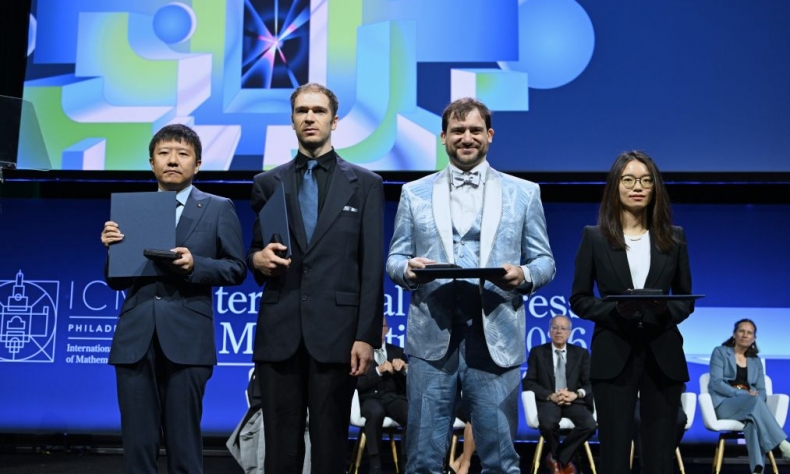
On July 23, at a ceremony in Philadelphia, the United States, the International Mathematical Union unveiled the recipients of the 21st Fields Medal. Two of the four laureates were from China: mathematicians Wang Hong and Deng Yu. It was the first time that Chinese nationals had claimed the highest honor in mathematics, an award widely considered the discipline’s equivalent of the Nobel Prize.
Both mathematicians received solid mathematical training in China’s basic education system. Wang from Guilin, Guangxi Zhuang Autonomous Region, earned a high score in the gaokao, China’s national college entrance examination, while Deng from Shenzhen in Guangdong Province claimed the 47th International Mathematical Olympiad gold in 2006. They entered Peking University in 2007. Wang pursued further studies in France and MIT; Deng studied at MIT and Princeton, and now teaches at the University of Chicago.
Against the current backdrop of escalating China-U.S. competition, interviews with the pair went viral on Chinese socials in late July.
For most ordinary people, where these scientists work is beside the point: What matters is that they are tackling problems that confront all of humanity. Wang, together with American mathematician Joshua Zahl, completed the proof of the three-dimensional Kakeya conjecture, a foundational result that may one day offer an entirely new analytical framework for fields that rely on wave packet interactions, including radar and remote sensing technologies, as well as signal processing. Deng, alongside mathematics professors Zaher Hani and Xiao Ma, delivered a complete mathematical proof of Hilbert’s Sixth Problem, laying rigorous groundwork for the theoretical frameworks underpinning fluid mechanics and statistical physics. The fruits of basic science like this do not belong to any single nation.
As Wang stated at the Fields Medal press conference held in her honor at the Institut des Hautes Études Scientifiques, “Mathematical research knows no borders. I truly hope that researchers and scholars from all over the world can exchange ideas without any restrictions.” She further noted that her academic experiences in France and the U.S. have been invaluable, and that her collaborators span the globe—from China and the U.S. to Canada and Europe. The same rings true of Deng’s work. Their achievements are the product of international collaboration and a crystallization of shared human intellect. At its heart, their story is one of openness, exchange and cooperation.
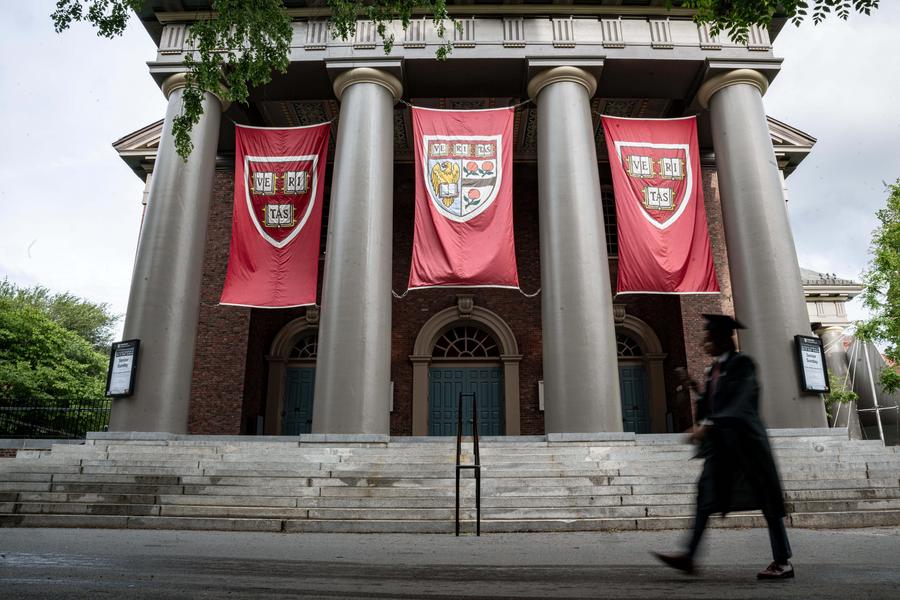
It is a story, however, that may grow increasingly rare. The tides of unilateralism, bloc confrontation and zero-sum thinking continue to surge. Scientific and technological progress, which ought to serve all of humanity, is being steadily warped into an instrument of great-power rivalry, as some countries erect technological barriers and fracture the networks of academic exchange.
Just a week before the two Chinese mathematicians received their awards, the U.S. Department of Homeland Security released a final rule on July 16 that tightens controls on Chinese international students and visiting scholars. The rule eliminated flexible renewal mechanisms for F student visas and J exchange visitor visas while shortening the grace period granted after completion of studies, the latest in a string of restrictive measures targeting Chinese students and scholars in recent years. Before this, the State Department had revoked and invalidated visas for enrolled Chinese students in successive waves, with those in STEM fields being singled out. Also in July, the National Science Foundation announced a strict ban on federal funding for any research involving Chinese restricted entities and their affiliated personnel. The so-called “restricted entities” encompass the vast majority of China’s universities, research institutes and key laboratories, effectively casting a shadow over nearly all normal Sino-American academic cooperation, joint research, and talent exchange.
“The best and brightest in Chinese tech are heading home faster than ever,” The Wall Street Journal reported on May 13, noting that a growing number of Chinese elites working in the U.S. are choosing to reverse the brain drain. Citing data from recruitment platforms, the report found that the number of Chinese international graduates returning home to enter the job market in 2025 rose 12 percent year on year, more than doubling since 2018. A survey of overseas Ph.D students told a similar story: The share of respondents planning to return to China after graduation surged from 38 percent in 2024 to 59 percent in 2025.
America’s strategic myopia is effectively eroding its own competitiveness. Viewed through a wider lens, though, when talent mobility and exchange between the world’s two largest economies falter, there is nothing to celebrate—least of all for the progress of human civilization. Because science, by its very nature, knows no borders.