China’s Trade Surplus Is Not from Unfounded “Excess Capacity”
 Facebook
 Twitter
 Linkedin
 Google +
The appropriate response, therefore, is to strengthen global trade and investment cooperation rather than resort to tariffs and other restrictions on trade and investment.
China’s Ministry of Commerce (MOFCOM) recently issued “China’s Position on the So-called Excess Capacity Issue,” responding to repeated blame from the U.S. and the EU. The document provides a solid elaboration on the excess capacity phenomenon by examining the historical evolution of global industrial production and supply chains. It also proposes a solution that is based on global cooperation rather than trade frictions, protectionism, or restrictive measures.
In recent years, China’s trillion-dollar trade surplus and strong export performance have triggered harsh reactions from the U.S. and the EU. Many in the West have revived the narrative of “China Shock 2.0.” Washington has been preparing to impose Section 301 tariffs targeting China over the so-called “excess capacity issue,” while the EU has been busy working with various acts or policies to check Chinese products.
Facts have repeatedly shown that a trade surplus is not necessarily linked to excess capacity, whether in China or elsewhere. China has experienced excess capacity in certain industries, such as steel, cement, glass, and traditional industries including apparel, shoes, and bags. However, exports from these industries have been declining in recent years rather than expanding. Over the past three years from H1 2023 to H1 2026, China’s export value of steel fell by 17.9 percent, glass by 13.4 percent, apparel, shoes and bags by 3.5 percent, 20.9 percent and 14.9 percent respectively.
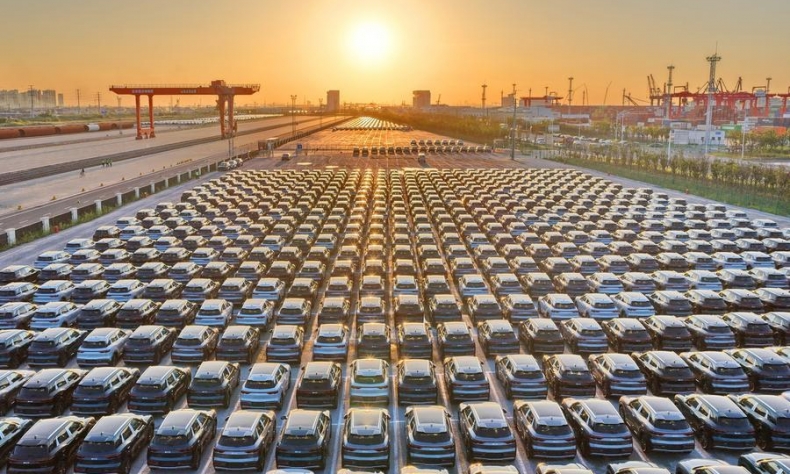
China’s rapidly growing exports of new energy vehicles are not evidence of so-called “excess capacity issue,” either. First, global demand for electric vehicles is still far from being met. According to estimates by the International Energy Agency (IEA), annual global EV production (including BEV and PHEV) is expected to reach 55 to 75 million units by 2035, while the total registration is projected to grow to between 510 million and 800 million. Second, during the first half of 2026, the net increase in China’s automobile exports amounted to $32.14 billion, far below the $86.88 billion increase in integrated circuit (IC) exports. Yet no one argues that China has excess capacity in IC, because imports of IC increased even more, rising by $106.74 billion. This demonstrates that strong export growth alone is not evidence of excess capacity.
Moreover, excess capacity could also coexist with a trade deficit. In the United States, for example, capacity utilization rates in the automobile industry stood at 69.6 percent, below the commonly cited 70 percent threshold. Yet, in the first five months of 2026 alone, the U.S. recorded a global trade deficit of $101.88 billion in automobiles and auto parts.
China runs a large trade surplus with the EU, while the EU, in turn, enjoys substantial trade surpluses with the U.S. and the U.K. If China’s surplus with the EU is taken as evidence of excess capacity, then by the same reasoning the EU would also have to be considered as having an excess capacity problem.
In fact, China’s strong export performance is largely the result of its unique competitive advantages in manufacturing and the consequent strong integration into the global supply chains.
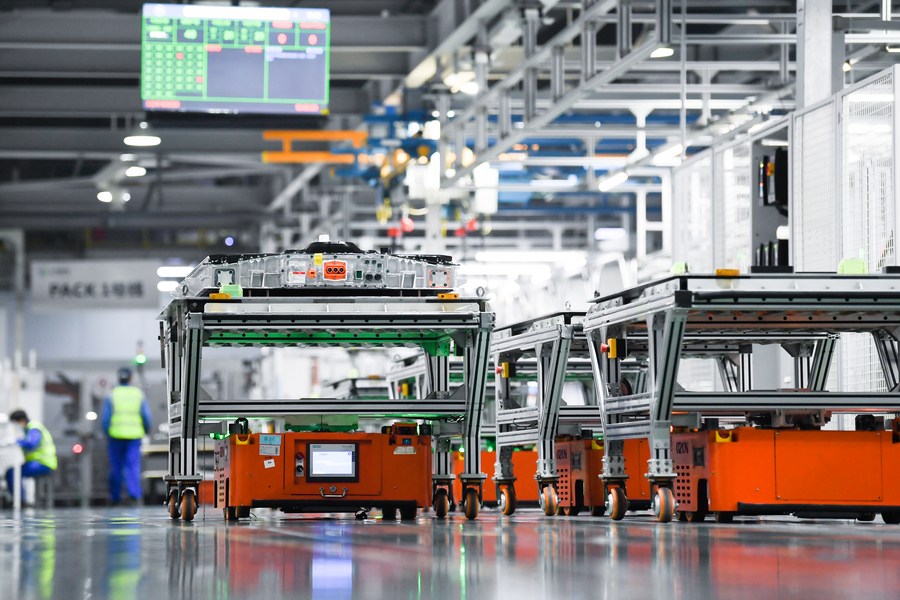
First, the advantage of scale. In 2025, China accounts for 32 percent of global manufacturing output, surpassing the combined shares of the U.S. (15.0 percent), Japan (6.3 percent), Germany (4.6 percent) and South Korea (3.3 percent). Such a massive scale brings down the cost. History shows that the U.S. automobile industry dominated the global market in the early postwar years because of its huge scale, with output exceeding that of Europe and Japan combined. Japanese cars were not competitive in the world market in the 1960s and early 1970s because of the lack of super large scale. In the late 1970s to early 1980s, Japan replaced the U.S. as the world’s largest automaker and thus its cars swept the U.S. and Europe because of the advantage of scale. Today, Chinese automobile output is larger than the U.S., Japan and Germany combined and logically more competitive than the latter.
Second, the advantage of complete supply chains. China is the only country in the world that possesses all industrial categories in the United Nations industrial classification. The clusters in the Pearl River Delta and Yangtze River Delta allow most components and parts to be sourced within hours of transportation. A notable contrasting example is Foxconn’s planned $10 billion liquid crystal display (LCD) panel factory in Wisconsin, announced in 2017. But 9 years later, the site became a Microsoft data center. The reason is simple: the project involves over a thousand procedures with many key parts from Japan, South Korea or China. In the Yangtze River Delta, all the supplies and processors could be done in 4 hours.
Third, China benefits from the advantage of large-scale infrastructure, including the world’s largest high-speed railway network, extensive highway systems, major freight networks, and widespread 5G connectivity. These infrastructure advantages provide strong support for manufacturing efficiency, logistics, and industrial competitiveness.
Fourth, the application of frontier technologies in manufacturing. China holds around 60 percent of the world’s AI patents and has focused on integrating AI widely into manufacturing. This has fostered the world’s largest ecosystem for smart manufacturing, creating a significant competitive edge that is difficult for other countries to challenge. For example, China has applied open-source AI models to the manufacturing of embodied robots and thus accounted for 84 percent of global output.
Taken together, these four advantages help explain why “made-in-China” products are competitive in global markets. The “dumping of excess capacity” does not withstand scrutiny.
However, China is not an export-led economy. In 2025, its industrial added value reached 41.68 trillion yuan, while the total output value reached 167 trillion yuan. Its export volume hit 26.99 trillion yuan. The World Bank data shows that, in 2025, exports of goods and services accounted for 21.1 percent of China’s GDP, compared with 22.3 percent for India, a global average of 29.5 percent, and 40.4 percent for Germany. Again, it proves that there is no logic that China exports its excess capacity, if any, to the world.
Electric vehicle is a focus of “excess capacity” blame on China, especially from the EU. Yet the rapid growth of China’s EV exports is driven by market demand. As a matter of fact, the EU is not the largest market for Chinese EVs. Among the top 20 importers of Chinese EVs during the first half of 2026, seven EU member countries—Belgium, Italy, Spain, Germany, France, Slovenia and Poland—together accounted for 23.5 percent of total Chinese EV exports, while three non-EU countries—Brazil, UK and Australia—together accounted for 26.1 percent, and the latter three countries have little complaint.
The world landscape of China’s trade balance could further topple the blame of “excess capacity”. In the first half of 2026, the U.S. and the EU together accounted for 55 percent of China’s total world trade surplus. The single largest surplus is with Chinese Hong Kong SAR (33.5 percent), followed by ASEAN (28.9 percent). Neither of them has echoed the U.S. and the EU. On the other hand, China has trade deficits with Japan, South Korea, Australia and New Zealand. There is no blame of “excess capacity” from these countries.
The appropriate response, therefore, is to strengthen global trade and investment cooperation rather than resort to tariffs and other restrictions on trade and investment. Protectionist measures, not China, will bring shocks to the world and hurt the Global South.
The article reflects the author’s opinions, and not necessarily the views of China Focus.