Magic Trains That Carry Wishes and Dreams
 Facebook
 Twitter
 Linkedin
 Google +
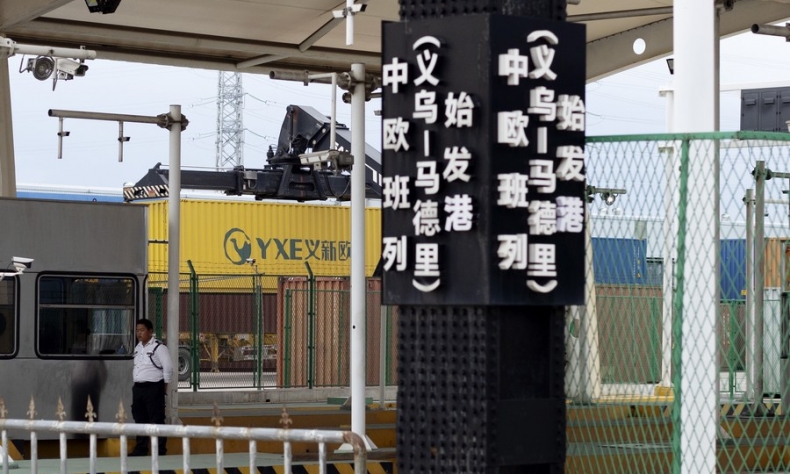
The China-Europe freight train (Yiwu-Madrid) serves as an international logistics corridor linking Asia and Europe and bonding people’s hearts together.
Jesús Antonio García García, a young Spaniard traveled across continents to Yiwu City, east China’s Zhejiang Province for love in 2014. Little did he know that just over a decade later, he would gain popularity on Chinese social media as a ham carver. Nor could he foresee that his destiny would become closely intertwined with a major international logistics artery which was launched that very same year.
Stretching 13,052 kilometers from Yiwu to Madrid, this vital transport link is the China-Europe freight train which departs from Yiwu, exits China via border ports in Xinjiang, and finally terminates in Madrid.
Cultivating an efficient market
When García first arrived in Yiwu, he was confronted with language barriers and cultural differences. Nevertheless, he soon spotted boundless business opportunities that city, known as the “world’s supermarket.” Spain produces premium red wine and ham, while the Chinese market boasts tremendous consumption potential. Before long, his cross-border business got off the ground.
Coincidentally, in 2014, another group of people in China were working tirelessly to turn an ambitious vision into reality. Back then, Yiwu was facing mounting logistics bottlenecks in exporting small commodities to Central Asia and Europe. Strong market demand gave rise to the idea of launching an international intermodal rail service. The proposal of the Belt and Road Initiative (BRI) in 2013 created a historic opportunity to realize this ambitious vision.
“With support from the local government, we put the first train into service in just 52 days,” recalled Ye Qiuran, vice president of Yiwu Timex Industrial Investment Co., Ltd., the operator of the train service.
The early days of operations were fraught with difficulties. “We had to source cargo ourselves container by container to get the service up and running,” Ye recalled. Embodied with this market-driven mindset, the freight train was popular right from its inception. To date, the freight train has completed over 16,000 round trips, transporting 1.36 million TEUs.
If market demand serves as the engine of the project, then targeted government services lay smooth tracks for its operation. Here in Yiwu, an effective market and a proactive government engage in positive interaction. When enterprises encounter practical difficulties during their development process, the government responds promptly to market demands and helps them find solutions.
For instance, traditional railway waybills carry no financial value in themselves, and thus constrain capital turnover for small and medium-sized enterprises. To solve this problem, Yiwu has taken the lead in advancing the reform to give the property right function to railway waybills. Simply put, railway waybills, previously merely cargo receipts, now have mortgage functions similar to property ownership certificates. Enterprises may secure bank loans with such waybills, unlocking the capital value of goods in transit and greatly easing cash flow pressure.
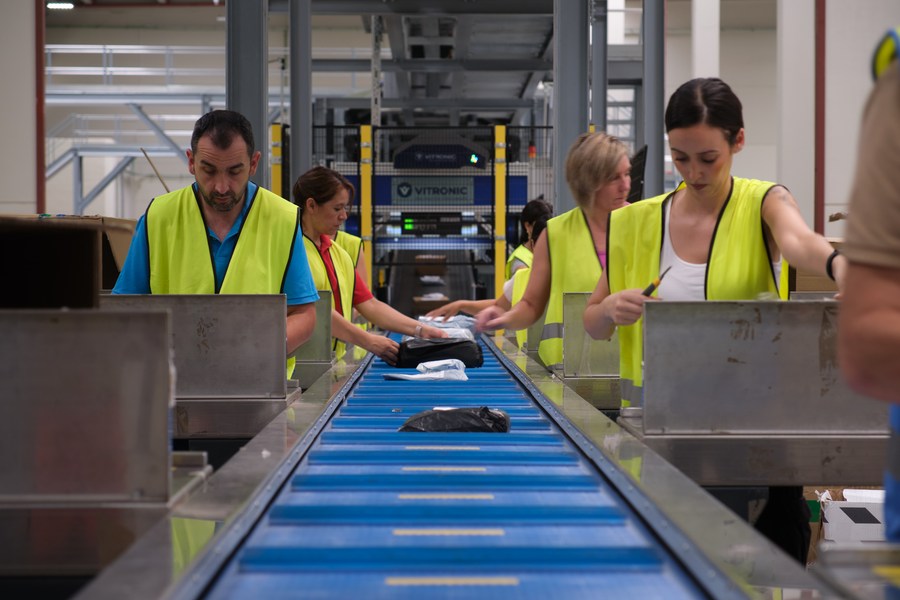
Another example, to tackle the barrier preventing cross-border e-commerce parcels from being transported by rail, Yiwu applied for and was approved as China’s first pilot for postal cargo transport via China-Europe freight train services. This opened a new gateway to global markets for numerous small and medium-sized e-commerce enterprises.
This distinctive model of concerted cooperation between government and enterprises has gradually addressed the common challenge of “full outbound trips and empty return trips” during the early phase of train operations. More importantly, with the robust consumption power in the Yangtze River Delta, it has achieved a dynamic balance between the volume of outbound and return freight.
Creating changes
Temperature-sensitive products such as red wine are particularly suitable for rail transport. Conventional shipping by sea takes about 60 days, and being transported in containers which are exposed to intense sunlight near the equator can severely damage wine quality. By contrast, rail transport takes a minimum of only 16 days, and the temperature and humidity control preserve the authentic taste.
Improved transport quality has reshaped the market. According to Kong Zhijian, the person in charge of Zhejiang Mengde Import and Export Co., Ltd., ham is a good example of these improvements. “After bone-in ham was introduced to the Chinese market in 2018, regular services of the railway express drove down the price of premium ham to under RMB 2,000, making such products accessible to ordinary Chinese households.”
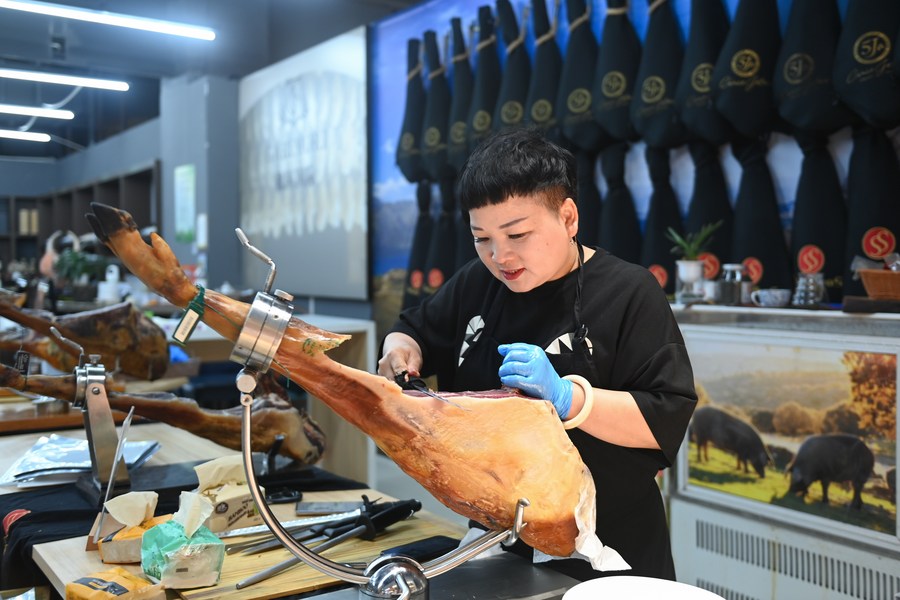
García’s business has also steadily expanded as a result of the growth of the railway express service, from just several containers a year during the early days to dozens of containers annually, with an annual trade volume reaching US $2 million. Riding the wave of livestream e-commerce, he has gained online popularity as a ham carver, introducing Spanish food culture to Chinese consumers.
Consumer goods are not the only category witnessing this transformation. According to Ye, during the early days, exported cargo mainly consisted of small commodities from Yiwu, but today, high value-added products including machinery, automobiles and auto parts, as well as photovoltaic products, account for the bulk of export cargo value.
“The focus of the government and market has shifted from simply pursuing the volume of train trips to improving operational quality,” said Ye. To this end, the operator has launched timetabled trains. By operating on fixed schedules and routes similar to high-speed passenger trains, these services deliver predictable supply chain performance for enterprises with stringent time requirements.
This international logistics corridor serves not only as a fast track for Made in China products to reach global markets, but is also a convenient gateway for quality goods from around the world to enter China. Data released by the Yiwu Municipal Bureau of Commerce shows that the city registered imports worth RMB 105.8 billion in 2025, representing a year-on-year increase of 32.3 percent.
Products transported back to Yiwu via the railway express, including Russian timber, Central Asian cotton yarn, European machinery, and maternal and infant supplies, are continuously distributed across China. This has greatly broadened the range of choices available to Chinese consumers.
Gains beyond business
If reshaping industrial chains represents the hard power of the China-Europe freight train, advancing people-to-people connectivity constitutes its soft power with greater long-term value. The trains carry not only goods, but also culture, friendship, and aspirations. They connect people from diverse countries and cultural backgrounds, transforming mere business partners into participants sharing development opportunities.
García’s personal journey is a vivid reflection of such in-depth integration. “The China-Europe freight train is like a matchmaker,” he said with a smile. “It not only brought my wife and me together, it also linked our business to two countries.”
In his spare time, he still cuts ham for customers and hosts livestreams at his shop. He is brimming with confidence about the future. “The first Chinese idiom I learned in Yiwu is ‘family harmony brings prosperity to all undertakings.’ My transnational family lives harmoniously together, and our cross-border business continues to thrive. I believe that as long as this transport route remains open, our good life will endure.”
Wheels roll and train whistles can be heard again and again. The China-Europe freight train (Yiwu-Madrid) serves as an international logistics corridor linking Asia and Europe, and bonding people’s hearts together. It transports not only goods, but also the dreams and livelihoods of numerous ordinary people linked by it. Guided by the BRI’s principles of extensive consultation, joint contribution, and shared benefits, more stories echoing the wisdom of “family harmony brings prosperity to all undertakings” are sure to be written along this rail of hope.