The Boom of China’s Sports Economy
 Facebook
 Twitter
 Linkedin
 Google +
In recent years, public enthusiasm for sports has continued to surge. The sports industry is poised to inject fresh vitality and sustained momentum into China’s economic development.
In recent years, policy incentives, consumption upgrading, and digital empowerment have transformed Chinese sporting events from purely competitive activities into cross-sectoral connectors that bridge consumption scenarios, industrial chains, and urban renewal, steadily converting event-driven traffic into significant economic dividends.
Boosting urban and rural development with sporting events
A single sporting event can unleash a ripple effect across ticketing, travel, accommodation, catering, and shopping, expanding the consumer footprint beyond stadiums to tourist attractions, city streets, and commercial hubs. As the calendar of events grows ever richer, these spillover benefits for urban consumption are becoming increasingly pronounced.
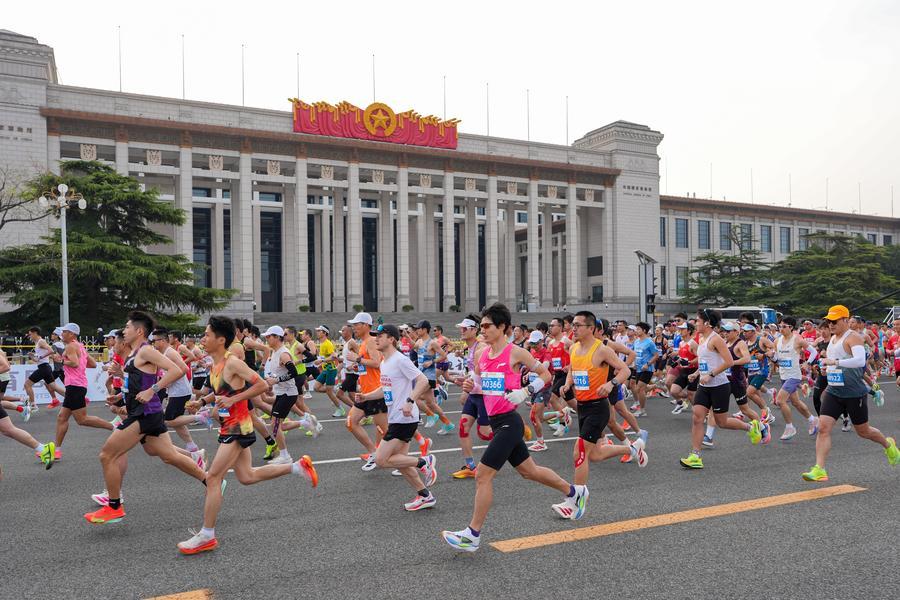
A growing number of Chinese cities are demonstrating strong capacity to host major international sporting events. Shanghai, for instance, has leveraged flagship events such as the F1 Chinese Grand Prix and the Shanghai Marathon (a World Athletics Platinum Label race) to deliver major economic returns. During the 2026 F1 Chinese Grand Prix, held from March 13 to 15, over 230,000 spectators attended in person, generating 190 million yuan (around US$28.18 million) in ticket revenue.
In 2025, Beijing hosted both the China Open tennis tournament and the World Table Tennis (WTT) China Smash. The former generated 88 million yuan (around US$12.96 million) in ticket revenue and over 12.5 million yuan (around US$1.84 million) in licensed merchandise sales, with event-derived consumption accounting for 35 percent of total spending. The latter brought in 87 million yuan (around US$12.81 million) in ticket sales and drove more than 30 million yuan (around US$4.42 million) in consumption at Shougang Park.
In recent years, Guangzhou has successfully staged events such as the Guangzhou Marathon and the International Dragon Boat Invitational Tournament, while Chengdu has consecutively hosted the World University Games, the World Games, and multiple high-level international competitions. These events serve as a springboard for urban upgrading.
Public sports events have likewise surged in popularity, fueling integrated development of culture, tourism, and commerce. The Guizhou Village Super League, known as “Cun Chao” in Chinese, has generated significant ripple effects: In 2025, driven by the event, Rongjiang County’s total tourism revenue reached 11.8 billion yuan (around US$1.75 billion), up 9.22 percent year-on-year. The Village Basketball Association tournament, dubbed by netizens as “Cun BA,” in Taijiang County has similarly boosted local tourism and effectively spurred consumption growth.
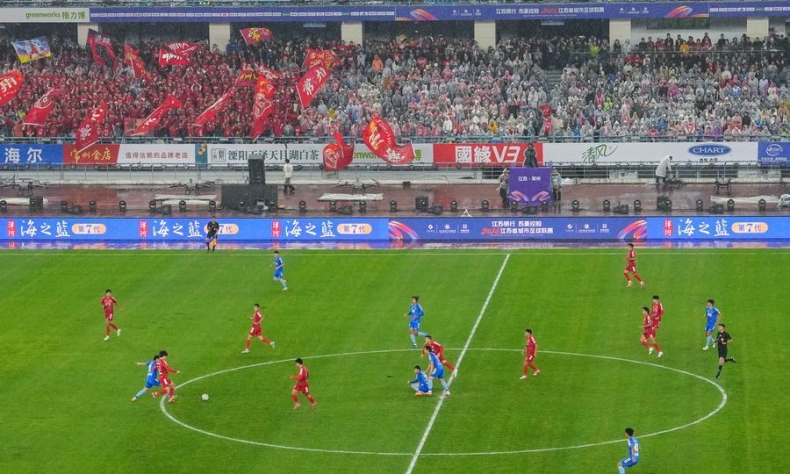
Regional collaborative hosting of such sporting events has emerged as a new highlight. In 2025, the Jiangsu Football City League, or “Su Chao,” attracted over 60,000 spectators per match and drove approximately 38 billion yuan (around US$5.6 billion) in multi-scenario consumption throughout Jiangsu Province. This year, the northeastern provinces of Jilin, Liaoning, and Heilongjiang joined hands with the Inner Mongolia Autonomous Region to launch the Northeast Super League, drawing tens of thousands of fans and steadily boosting the region’s cultural tourism appeal.
From factory to arena
Sports events generate enormous demand for equipment, which in turn accelerates the development of China’s sporting goods manufacturing industry.
In late March 2026, ZXMOTO, a Chinese motorcycle brand founded in 2024 and named after its founder Zhang Xue, secured a double victory at the World Superbike Championship. The win drove its sales to soar, with its nationwide dealership network expanding by 12 stores in just 20 days to reach 257 outlets. According to a senior executive from the company, ZXMOTO sold 25,000 motorcycles in 2025 and has set a sales target of 60,000 units for 2026. The overseas triumph is helping shift motorsports from a niche pursuit into a mass-market economic driver, pointing to vast future potential.
As a key global manufacturing hub for sporting goods, Fujian Province consistently sees a spike in export orders during major events like the World Cup and the Olympics. In the first four months of 2026, Fujian’s exports of sporting goods and equipment reached 4.28 billion yuan (around US$630 million), up 6.9 percent year-on-year. As a global distribution hub for sporting goods, Yiwu in Zhejiang Province accounts for roughly 70 percent of the global market share in World Cup merchandise sales. In the first half of 2026, the city’s total exports reached 6.22 billion yuan (around US$916 million), with products shipped to 204 countries and regions. Following the conclusion of the 2026 FIFA World Cup, sustained replenishment demand for commemorative merchandise and cultural creative products continues to tap into the long-tail dividends of the event-driven economy.
China’s sports industry is now steadily advancing toward its target of reaching a total scale of 7 trillion yuan (around US$1.03 trillion) by 2030.
Revitalizing dormant urban spaces
Hosting sporting events has spurred a continuous evolution of urban infrastructure and public spaces, repurposing them for new functions and broader public use. At Beijing’s Shougang Park, for example, the ski jumping venue has been reimagined with rock-climbing walls and sledding tracks while the former cooling towers have been converted into a sunken basketball park, offering sports enthusiasts a unique experience.
During the 15th Five-Year Plan period (2026-2030), China aims to develop approximately 100 high-quality outdoor sports destinations covering a range of activities including snow and ice, mountain, water, and aviation sports. Already, countless new venues and facilities are emerging, many of which are breaking seasonal and weather constraints, making year-round sports participation a reality. For instance, the first Olympic-standard wave pool in Wanning, Hainan Province, can generate 23 different wave types ranging from 0.3 to 2.7 meters in height, making surfing a year-round activity, free from the whims of weather and seasons. In early 2026, Chengdu, the capital of Sichuan Province, opened an indoor ice-climbing facility spanning over 1,600 square meters. By early July, it had already received more than 20,000 visitors, offering a refreshing new alternative for sports enthusiasts.
In recent years, public enthusiasm for sports has continued to surge. In 2025, 38.5 percent of China’s population regularly participated in physical exercise, while per capita sports spending among residents aged 19 to 59 reached nearly 2,500 yuan (around US$370), an increase of 38 percent from 2020. As regions across the country explore event-hosting models tailored to their unique strengths, the sports industry is poised to inject fresh vitality and sustained momentum into China’s economic development.