A Month in Motion
 Facebook
 Twitter
 Linkedin
 Google +
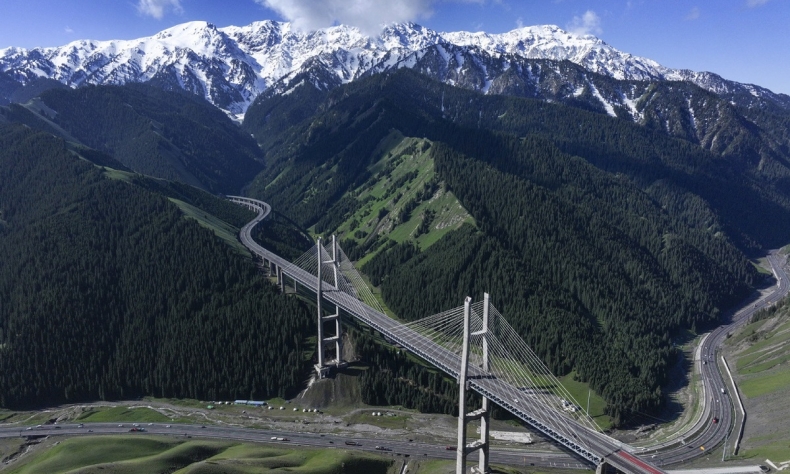
To understand a place in depth, you need to actually live there as a local.
Arnaud Bertrand, French entrepreneur, writer and social media influencer, has over 400,000 followers on X. He spent the summer of 2026 traveling across Xinjiang with his wife and two young daughters in a rented RV—from Urumqi to the Kizil Caves, across the Taklimakan Desert, and into the lavender fields of Yili (Ili) Kazak Autonomous Prefecture, where he found a piece of home. Toward the end of his journey, he sat down with Xinjiang Today to share his observations. Edited excerpts from the interview follow:
Xinjiang Today: Your month-long RV trip has come to an end. For many people, Xinjiang is widely discussed but rarely visited in person. What are your thoughts on it now?
Arnaud Bertrand: I had read a lot about Xinjiang before, but there were still a few unexpected dimensions during the trip. One aspect is I didn’t expect Xinjiang to be so multi-ethnic, because Xinjiang is always associated with the Uygurs. And it’s true of course that there are many Uygurs in Xinjiang, but actually Xinjiang is massive. It’s three times bigger than France. The diversity you can see here is almost comparable to the diversity of a little continent in itself. You can see so many different ethnicities, so many different types of lifestyle. If you go somewhere in the mountains, you find Mongolians. If you go down in the valley, you see Kazaks and Kirgiz and Tajiks. And then if you go into the desert, in some of the oases you see the Uygurs. So it’s extremely diverse, also diverse in terms of landscape and climates. There’s a saying in Xinjiang that when you travel through the region, you can experience the four seasons.
You chose the Kizil Caves as your first stop. How do you see their place in the history of the Silk Road and the eastward transmission of Buddhism?
The reason we picked this place is that during our first RV trip, which was mostly in Gansu Province, we went to a place called Dunhuang, to the Mogao Caves. And that was really the highlight of our trip back then. Then I heard that Xinjiang has caves that are similar to Mogao, but which predate Mogao by two centuries. I was simply very attracted by that. It didn’t disappoint. The quality of the paintings, especially when you think that it’s 1,800 years old, is extraordinary.
There are a few obvious differences. Most of the murals here seem to have some sort of diamond grid structure, which you don’t see in Dunhuang. And also, you really can see that there was an evolution. Dunhuang is in a way much more sinicized, much more Chinese, because it depicts progression of Buddhism inside China. The Kizil Caves were a key hub on the Silk Road, and it is from this very place that Buddhism started to appear in China. So first here, and then it progressed east. What’s interesting here is you can still see a lot of foreign influence—Indian, Greek, Persian—which you see much less in Dunhuang.
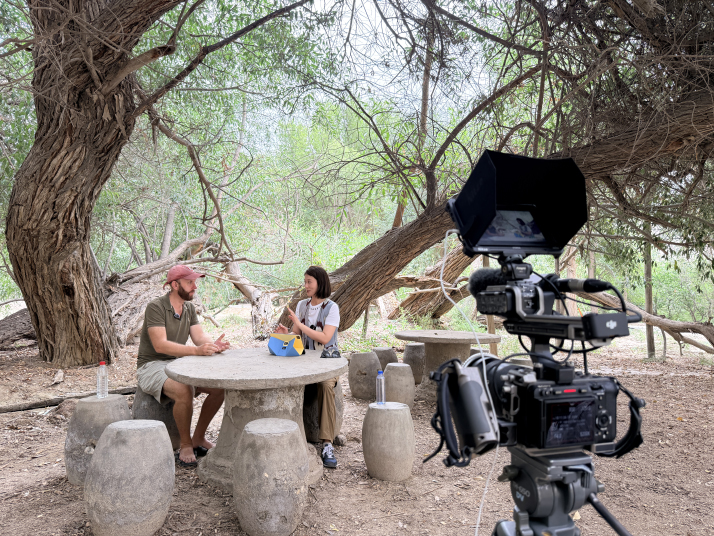
What was it like to travel across Xinjiang in an RV for a month as a foreign visitor? What advice would you give to other foreign tourists planning a similar trip?
It’s been an incredible journey. The way Xinjiang differs is the driving experience. You have so many different landscapes, and it feels like you constantly need to change your style of driving. In south Xinjiang, like in Kashi (Kashgar), the style is pretty sportive. But if you drive on those smaller roads in the mountains, you can’t drive like that. What I really like about driving an RV in China is the freedom. You can park pretty much anywhere and spend the night there. In France, you cannot park an RV just everywhere; you have to park it in designated camping sites; so there is actually more freedom in China in that regard.
The quality of the roads on average is pretty exceptional, especially given how extreme the conditions are in some places. We went to some of the highest mountains in the world, climbed a glacier on a mountain that’s 7,500 meters high. We also went through the Taklimakan Desert, one of the most extreme deserts on Earth. What China did around the desert is building a green belt to contain it. You can see so much effort went into building infrastructure in this region.
You do need to speak Chinese, because most people don’t speak English here. So as a foreigner, that would be the biggest hurdle. My advice would be: Have a good translation app with you or travel with someone who speaks Chinese.
I had a medical issue when driving, partly because of the change in altitude, which is very drastic in Xinjiang—from 4,000 meters down to minus 200 in Tulufan (Turpan) in the span of hours. I had an episode where I almost passed out. I went to the hospital in Kashi; and in two or three hours I saw two specialists, did an MRI, ECG and CT scan. It was very efficient and reassuring.
Maybe I would choose to pace myself a bit more. The rhythm of our trip was extremely intense. We never stayed more than one day in the same place, drove continuously every day, visiting two or three sites. There’s an expression in Chinese: “special forces-style traveling (extremely fast-paced, high-intensity travel).” My advice would be to stay two, three, four days in one place and take time to explore, because Xinjiang is huge.
You have a cross-cultural family. What does this long journey with your two daughters mean to you?
I really like trips like that. That’s actually our typical style of holiday. We just love that touch of adventure, driving into the unknown in an RV as a family. My wife is Chinese. I’m French. I’m really, really keen to educate my kids in two cultures. That’s why trips like that are so important to me, so they understand Chinese culture better, they practice their Chinese and they meet kids their age on the way. That’s really important. When you have mixed kids, it’s very important that one culture does not overtake the other—that they have a similar amount of knowledge in both cultures, and they’re similarly proud of both. And you can only be proud of something if you have knowledge about it.
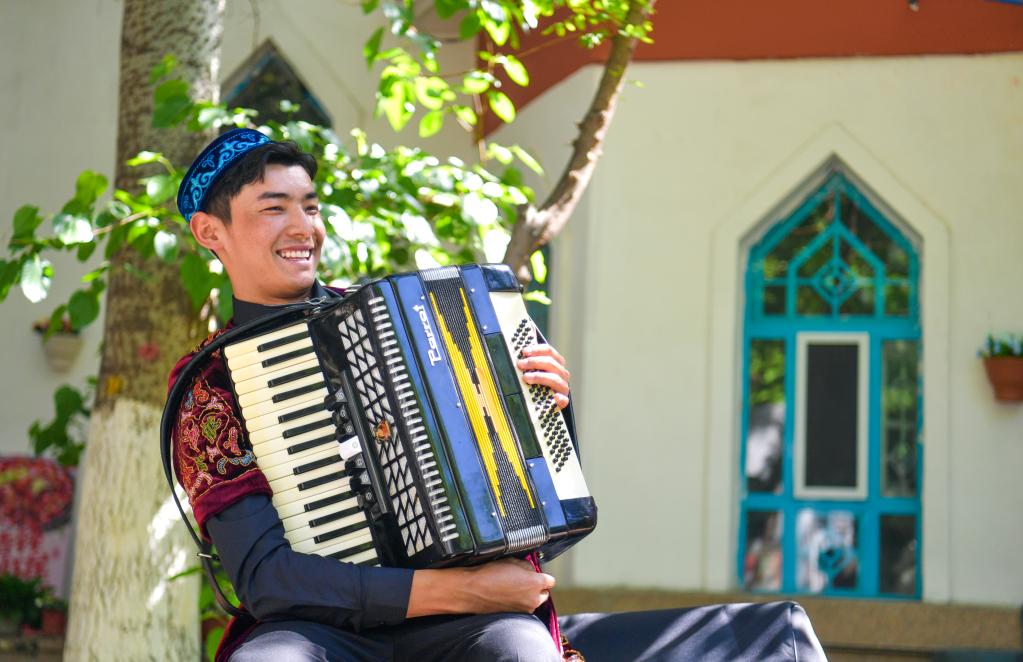
Western media have made various accusations about Xinjiang, including charges of “cultural genocide.” Having yourself traveled through multiple areas with high populations of ethnic minorities, what did you see?
It’s pretty astounding the degree to which they’ve all kept their identity. When you go in the Kazak area, you really see them living a complete Kazak lifestyle—eating Kazak food, speaking the Kazak language, following Kazak customs and festivals. Even young people. When we were in the mountains, we walked for hours and at the end we saw a small Kirgiz yurt. There were two young boys, 12 and 14, speaking Kirgiz, living in the yurt, raising horses and cows. During the other seasons, they go down to the town to go to school, where they’re with all the other ethnic groups of China and learn Mandarin. But every summer, they go back to their yurt. So they fully preserve their Kirgiz lifestyle and identity while also learning to live in a multi-ethnic society.
Western media’s accusations of “genocide” or “cultural genocide” are the complete opposite of reality. I actually expected Xinjiang to be more Han-influenced than it actually is. I never expected the cultures of the different local ethnicities to be that well preserved. China does the best job in the world at helping people preserve their own culture, giving them freedom, encouragement and subsidies. Uygur culture is celebrated, not erased. In Kashi, we filmed a young boy dancing on the street. He was 8 or 9 years old, and his dancing was extraordinary. I’ve never seen anything like it in my life.
You shared your journey in real time on social media. How did people respond? After a month of travel, how would you summarize your understanding of Xinjiang?
I was surprised that I received overwhelmingly good feedback. Going into Xinjiang, with what’s been told about Xinjiang, I was expecting some pushback, but I had virtually none. People were surprised at how beautiful Xinjiang is. We visited some places that really look like heaven. I posted continuously to show what we were experiencing in real time without any filter.
Short social media posts can’t truly represent a place as complex as Xinjiang. You’re never going to be able to convey it. I’ve been here for 31 days and I don’t think I’ve even started to comprehend the place completely. You should come here yourself. What I posted might be a nice teaser, but you’re not going to really understand this place before you come here.
Some things confirmed what I expected, some things were unexpected. I didn’t expect it to be so multi-ethnic. Half of our trip was more with Kazak or Kirgiz than with Uygurs. We visited central and south Xinjiang, but not the north or the east. Even though we drove every day, we’ve seen maybe a quarter of it. And I haven’t experienced daily life. We were always on the move, so I’ve seen it as a tourist. To understand a place in depth, you need to actually live there as a local.
We had so many beautiful meetings with local people. One moment that touched me quite a bit was in Yili. Yili looks very much like my native home in Provence, France, surrounded by lavender fields. When I arrived in Yili, I saw lavender fields and felt almost home. We met a local lavender farmer who brought us to his lavender essence factory. I grew up around lavender farmers in my childhood, and it was almost like seeing someone from my childhood, in China. That was a very special moment.