Washington Must Radically Rethink Its China Policy
 Facebook
 Twitter
 Linkedin
 Google +
For Washington to rethink its China policy means dropping the lingering zero-sum Cold War mentality.
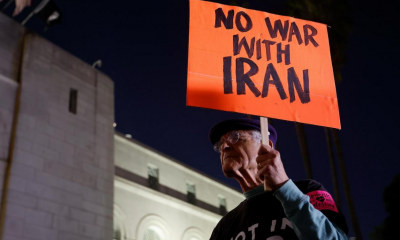
The forthcoming meeting between Chinese President Xi Jinping and U.S. President Donald Trump offers prospects for improving relations while questions remain. The Trump Administration is in internal disarray and faces challenges from a new potentially hostile Congress. Meanwhile, Washington is entangled in two major unnecessary wars: Ukraine and Iran.
Geopolitically, the United States is increasingly alienating itself from the international community owing to its bellicose foreign policy which violates international law and spreads destruction around the world. At home, public opinion has shifted against then Trump Administration. Polling data shows that over half the population is against the Ukraine and Iran wars. The public is concerned about a failing economy and disappearing jobs, inflation and affordability, and law and order.
Topics on the agenda
The Taiwan question, as usual, looms large but topics with an economic focus are prominent. There is the tariff war and trade war launched by the American side. These include export controls on U.S. semiconductor chips. There is the Chinese response to those which includes the sensitive rare earth minerals question. There is also the controversial Artificial Intelligence (AI) issue.
Looking at various trade problems, we find divergence over Boeing aircraft purchases, U.S. spare parts for aircraft, recent blocks on the importation of Chinese robots, drones, and routers, and the like.
To sum up, for the Chinese side, such problems as these may be considered violations of a “constructive strategic stability” framework agreed on during the May meeting.
Looking ahead
It is always constructive for countries to improve communications at the highest level. So the meeting between the two presidents should be welcomed. It is when there are no high-level communications that one gets worried about the relationship. So with this in mind, it is a positive sign that the two leaders are scheduled to meet. Regular communication and meetings in person between leaders can not only clarify concerns but they can lead to reduced tensions and improved cooperation.
What is essential is a vision for the long term. That means a vision for stable and constructive relations over time. Reduction of tensions and elimination of points of friction is the task of diplomacy.
At some point, and the sooner the better, Washington must drop its destabilizing Taiwan policy. Taiwan is a part of China as a province just as Hawaii is a part of the United States as a state. Washington politicians playing the so-called “Taiwan Card” of the Cold War era, and using Taiwan for so-called “leverage.” This is a counterproductive posture. It is regrettable that so-called geopolitical advisors in the Trump Administration still recommend playing the counterproductive “Taiwan Card”. Such an amateurish game is fundamentally dangerous.
Tariff and technological wars are no way to conduct a constructive foreign policy. They are destabilizing the situation. The United States and China must work towards fully normalized trade relations, without which there can be no “strategic”, meaning long-term, stability. Of course, there will be some issues but these must be managed responsibly.
There are many ways for countries to cooperate and thus to promote mutually beneficial relations. The economic dimension is but one area. Scientific and technological cooperation, educational cooperation, and cultural cooperation are also important. People-to-people relations are a fundamental foundation on which to build a long-term positive relationship.
China and the United States could cooperate on pressing global challenges such as the environment and climate change as well as on peace promotion. As for the latter, Washington could join with Beijing and Moscow to promote peace in the Middle East.
With the correct mindset, Washington could cooperate with China on global governance and on the strengthening of international law and international organization.
Rethinking China policy
Washington must radically rethink its China policy. For an administration, this requires an overall inter-agency “policy review” on an accelerated basis. But a rethink must go beyond this. Both political parties must agree on some fundamentals so that whichever party takes the White House it shares these fundamentals.
Of course, there can be disagreements on various policy matters of lesser importance than great power relations. For Chinese political leaders to think long term is to be expected, given China’s five-thousand-year history.
For Washington to rethink its China policy means dropping the lingering zero-sum Cold War mentality. It is 2026 after all and the world has changed and is changing. The Trump Administration must wake up to new international realities and must support peace and development. There can be no better place to begin than by constructive engagement with China.
The article reflects the author’s opinions, and not necessarily the views of China Focus.