Tulufan Is Hot, Hot, Hot!
 Facebook
 Twitter
 Linkedin
 Google +
From the Karez system to the drying houses, and from hot-sand therapy to factories in the Gobi Desert, one wisdom runs consistently throughout: Do not fight against nature, but go with its flow.
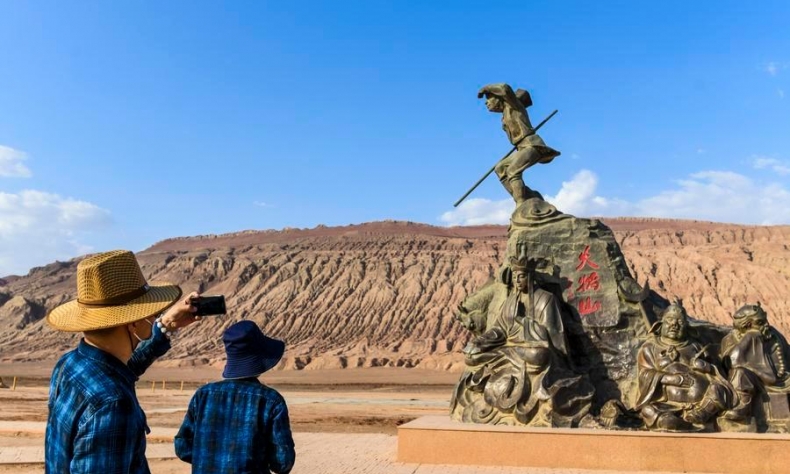
The mere mention of Tulufan (Turpan), often dubbed China’s “land of fire,” will always remind outsiders of its intense heat. The signature local attraction, the Flaming Mountains, was made widely known by the 16th-century literary classic Journey to the West. This fantasy novel recounts the pilgrimage of the monk Xuanzang and his disciples, featuring the legendary episode of the Monkey King borrowing the Banana Fan three times to extinguish the mountain’s fires.
The real-life Tulufan is indeed the “hottest place in China”: On July 13, 1975, an extreme maximum temperature of 49.6 degrees Celsius was recorded, and the ground surface temperature once reached 89.2 degrees Celsius. Experiencing more than 100 days a year with temperatures exceeding 35 degrees Celsius, this city has a history defined by thriving in the heat: The Karez irrigation system, built 2,000 years ago, channels meltwater from the snow-capped mountains underground; grapevines use the scorching sun to accumulate sugar; the hot sand is used for healing in the way of sand therapy; and the high temperatures are used to test Chinese-made products. The very same “heat” has gradually transformed from an ordeal to be endured into a resource that can be harnessed.
Hottest place, sweetest oasis
China’s lowest point on land is the Aiding (Ayding) Lake in Tulufan, where the average annual precipitation is about 16 mm, yet evaporation exceeds 3,000 mm. It is evident that China’s hottest, driest and lowest places are all packed into Tulufan.
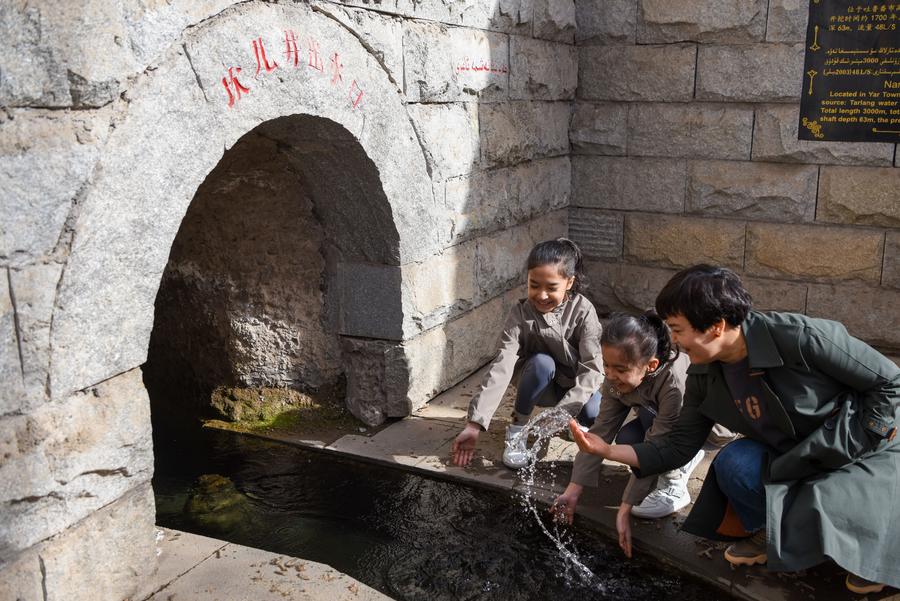
Local people did not simply endure the harsh conditions; instead, they found a way to survive by following the cracks of nature. The Karez system is the answer: At regular intervals, vertical wells are sunk, connected underground by hidden channels, allowing the subterranean flow from the Tianshan Mountains to run by gravity all the way to the oasis, where it is then drawn through open channels and reservoirs—avoiding evaporation under the scorching sun throughout the entire journey. According to data from the Water Resources Department of Xinjiang, there are currently 1,540 Karez wells in the autonomous region, of which 1,108 are in Tulufan.
In September 2024, the Karez wells were inscribed on the World Heritage Irrigation Structures list. The system already took shape as early as the Han Dynasty (202 B.C.-A.D. 220). “During their construction, men, regardless of ethnicity or age, went down the wells to dig, while women brought food and water. Every single well bears the historical imprint of united efforts, shared hardship and co-prosperity,” Wang Long, head of the Institute of Archaeology at the Tulufan Academy of Tulufan Studies, said.
With water secured underground, the heat above ground became a gift. Ancient grapevines unearthed from the Yanghai Tombs in Tulufan confirm that grapes were already cultivated in the area over 2,300 years ago; today, the region boasts more than 550 varieties and is known as the “World Grape Botanical Garden.” According to the city’s 2025 statistical bulletin, its grape cultivation area reached approximately 42,187 hectares, with a total output of more than 1.7 million tons, a year-on-year increase of 5.3 percent. Locally produced fresh grapes, raisins and wine have been exported to 39 countries and regions.
The extreme environment did not cut off exchange; on the contrary, it propelled Tulufan into a convergence of civilizations along the Silk Road. In the 1960s, a Tang Dynasty (618-907) manuscript was unearthed from the Astana Tombs in the area. Dating back to 710, the scroll features 178 lines of The Analects of Confucius, a renowned collection of teachings from the ancient Chinese philosopher, copied by a 12-year-old local schoolboy. At the end of his assignment, the child left a secret, heartfelt plea: “Master, I have finished my writing today. Please do not scold me for being slow; tomorrow is a holiday, so please let me go home early.”
The longing of a frontier town schoolboy from 1,300 years ago for a day off is no different from that of today’s elementary school students. Also unearthed in Tulufan are bilingual manuscripts in Chinese and Syriac, and on the murals of the Thousand-Buddha Caves, monks of different skin tones stand side by side.
The 1,491 immovable cultural relics, the seven religions that once flourished there, the 19 scripts and the 25 languages all attest that Tulufan was a site where civilizations met.
Curling hot sand
If the Karez wells and grapes represent the ancient people’s answer to “adapting to the heat,” today’s Tulufan has begun to “transform the heat.”
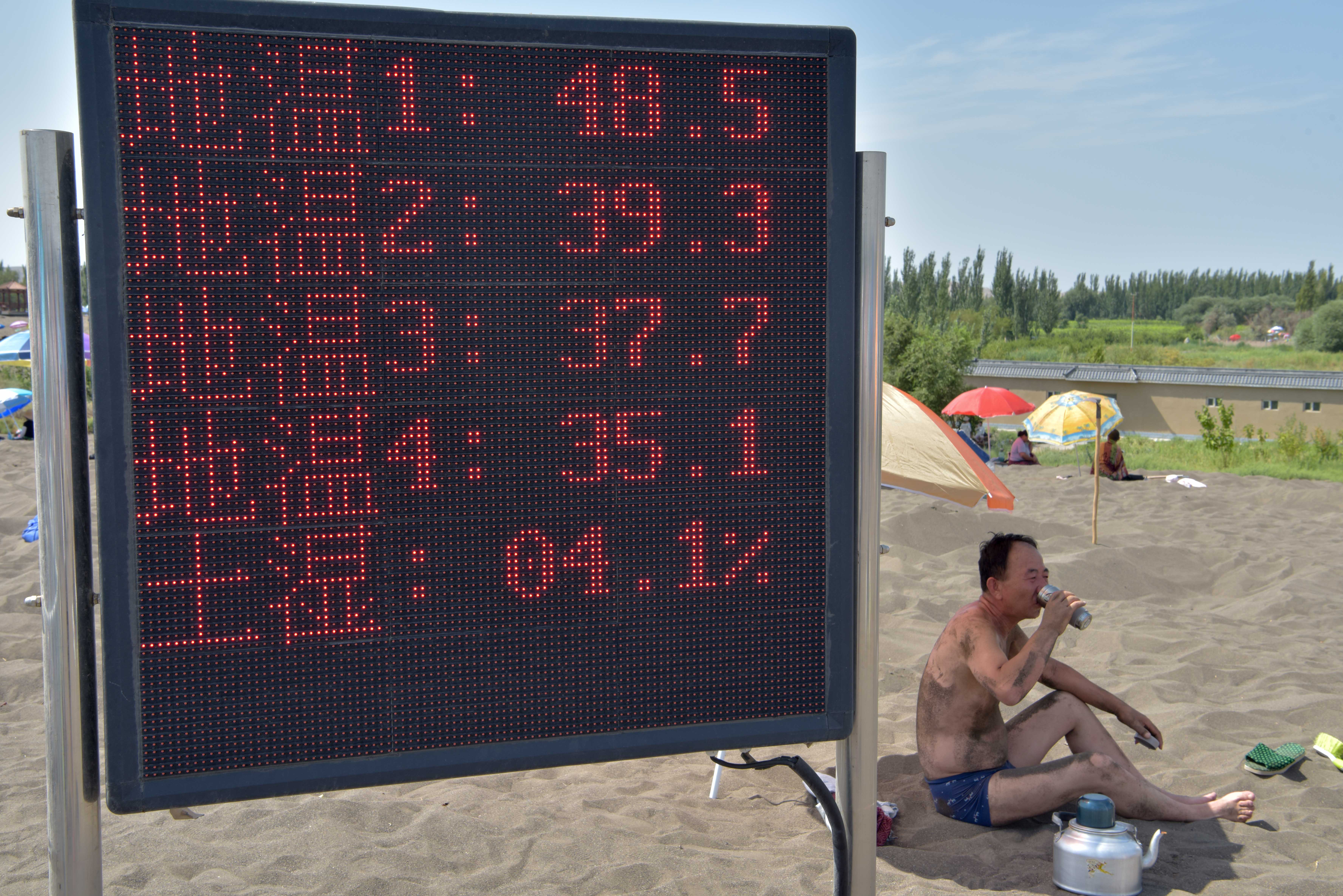
Sand therapy was already recorded in Tang-era medical texts and was inscribed on the National Intangible Cultural Heritage list in 2014. At the 22-hectare standardized sand therapy site of the Tulufan Uygur Medical Hospital, people bury themselves in sun-baked hot sand, where the combination of heat therapy, pressure, magnetism and mineral composition embodies the traditional Chinese medical principle of addressing chronic illnesses that tend to flare up in winter through summer treatment. Patients suffering from rheumatism and arthritis can benefit greatly from this practice.
This ancient practice has now been integrated into the modern system: On-site registration is available with just an ID card and medical insurance card, and patients from outside Xinjiang can have their medical bills settled through a cross-provincial service system. On June 8, China’s first sand-therapy-dedicated weather station began operation, providing real-time ground temperature data from zero to 1 meter underground in 10-cm intervals. During peak seasons, daily visitor numbers exceed 1,500, with tourists coming specifically from coastal regions of China and even Southeast Asia.
The two sand-therapy bases in Gaochang District and Shanshan County of Tulufan have both been rated as autonomous-region-level wellness tourism demonstration bases, with therapy, scenic spots and homestays forming an integrated industrial chain.
Attracted by the heat are also tourists: In 2025, Tulufan received 39.1681 million tourist visits, an increase of 22.4 percent year on year, with total revenue from tourism reaching more than 30 billion yuan ($4.4 billion), up 20.6 percent.
For the first time, the heat has transformed from weather to be endured into a resource that can heal, be capitalized on and boost incomes.
‘Roasting ground’
Speeding along the national highways or expressways that run through the outskirts of Tulufan, passengers can occasionally spot a few earth-yellow or brick-red drying houses amid the lush grapevines.
These buildings are perforated with lattice holes on all four walls, resembling beehives from a distance—they let the dry, hot wind flow through while blocking direct sunlight. Fresh grapes hung inside are turned into raisins by the hot wind in just 20 to 30 days, without any fire or a single kilowatt-hour of electricity, with 5 kg of fresh grapes yielding 1 kg of raisins.
According to local experts, builders deliberately choose windy spots for construction, aligning the holes on all four walls to face one another; today, roughly two out of every three farming households own a drying house, which locals affectionately call the farmer’s “second home.”
Others build machines to fight the climate, while the locals in Tulufan channel the hot wind into their homes and turn it into sweetness—this is the very origin of the “heat industry.” When manufacturers around the world must answer the question of whether their products are reliable under extreme heat, Tulufan’s climate itself acts as a scarce factor of production.
At the exposure test field of the Xinjiang Tulufan Natural Environment Testing and Research Center, photovoltaic panels, sealants and home appliance casings are lined up neatly, ready to face the extreme test of combined high temperatures, windblown sand and large day-night temperature differences.
“An artificial laboratory cannot replicate the real working conditions of combined high temperature, drought, dust and large day-night temperature differences,” Deputy Director Guo Chunyun said.
At noon on the test track, drivers lap in un-launched new cars covered in camouflage. Tulufan’s five bases handle more than 90 percent of the country’s dry-heat automotive testing and during peak season, more than 100 automakers, over 5,000 vehicles, and more than 4,000 engineers are stationed on site.
The supporting industries are releasing livelihood dividends. Car manufacturer Geely’s dedicated testing base alone has employed 82 local residents as test drivers. During peak season, large numbers of visiting engineers are stationed on site, directly boosting the prosperity of sectors such as accommodation, catering and transportation. Official statistics show that the vehicle testing industry directly boosts nearly 80 million yuan ($11.92 million) in local consumption each year, while related supporting services generate more than 100 million yuan ($14.91 million) in indirect income growth.
In 2025, the city’s per-capita disposable income stood at 32,747 yuan ($4,880), a rise of 6.4 percent year on year.
From the Karez system to the drying houses, and from hot-sand therapy to factories in the Gobi Desert, one wisdom runs consistently throughout: Do not fight against nature, but go with its flow. The fiery red of the Flaming Mountains will not change; what has changed is the relationship between people and the heat. The “Land of Fire” remains, yet this place has long become a land of promise.