A Closer Look at China’s Currency and What Really Drives the Country’s Export Strength
 Facebook
 Twitter
 Linkedin
 Google +
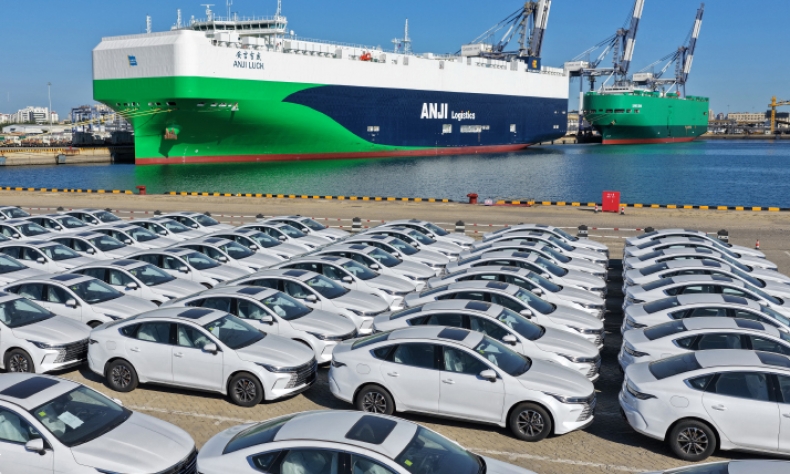
During the 15th Five-Year Plan period (2026-30), China will transform its growth model, expand domestic demand, deepen high-standard opening up and accelerate its evolution from the world’s manufacturing powerhouse into a core market for global demand.
On October 14, the General Administration of Customs (GAC) of China reported a striking number: The country’s trade in goods hit 39.94 trillion yuan ($5.97 trillion) in the first three quarters of this year, up 18.8 percent from a year earlier. Exports rose 16.4 percent and imports expanded 22.3 percent.
A week earlier, on October 8, the People’s Bank of China (PBOC), the central bank, issued The PBOC’s View on the RMB Exchange Rate, a seven-part document laying out its positions on the renminbi (RMB), China’s currency, and its exchange rate.
The timing was no accident. A narrative has taken hold internationally: The RMB is “undervalued,” or deliberately kept cheap, which gives China an unfair export advantage and explains its trade surplus, and it should rise in value.
In recent years, this issue has come up at Group of 20 (G20) finance ministers’ meetings, International Monetary Fund (IMF) annual meetings and China-European Union consultations.
So why is China’s trade so strong? And how much does the exchange rate actually matter?
An upward curve
China’s trade growth has climbed steadily all year: 15.3 percent in the first quarter, 18.3 percent in the second and 22.3 percent in the third.
“The growth rate for the first three quarters was the fastest for the same period in the past five years, and China remains the world’s largest trader of goods,” Wang Jun, deputy head of the GAC, said at a State Council Information Office press conference on October 14.
The trade structure is also upgrading. Equipment manufacturing, including machinery, electronics and transport equipment, drove nearly 90 percent of export growth. Intermediate goods, components used in production elsewhere, like chips or auto parts, made up more than half of export value, anchoring global supply chains.
Exports are also shifting toward hi-tech and green products: Integrated circuit exports surged 99.1 percent, while electric vehicles, lithium-ion batteries and wind turbine parts grew 72.3 percent, 36.4 percent and 22.4 percent, respectively.
And trade is becoming more balanced. Imports grew faster than exports for more than 110 countries and regions, a trend Wang attributed partly to China’s “super-sized market” effect and its steady opening up.
The result is an increasingly complementary structure: China is not only a “world factory,” but an open “world market.”
Yet many in the West argue that the above achievements stem from an “undervalued exchange rate.”
Trade and the currency
The PBOC statement is clear: China’s trade growth is driven by its growing industrial competitiveness in the global market. China has no need or intent to gain competitive advantages through currency devaluation, nor has it ever resorted to competitive devaluation.
“In the past, many orders were secured mainly on price. Today they are won more on technology, quality, logistics efficiency and service,” Guo Yingfeng, an associate research fellow with the China Center for International Economic Exchanges, told newspaper China Youth Daily.
Exchange rate movements now affect profit margins but rarely decide where orders go. High-value-added products, technology-intensive and backed by timely delivery, are less exposed to currency swings. China’s trade is becoming less sensitive to exchange rate fluctuations, Guo said, because the structure of its exports has changed.
Moreover, as Chinese manufacturing becomes deeply embedded in global chains, more companies are both exporters and importers. A weaker RMB lowers the foreign-currency price of some exports, but also raises the cost of imports.
The two effects often offset each other, further reducing sensitivity.
“China’s foreign trade cannot be reduced to a single relationship with the exchange rate,” Zhou Mi of the Chinese Academy of International Trade and Economic Cooperation told newspaper China Daily.
The PBOC data are, in a sense, counterintuitive. Between 2005 and 2008, the RMB appreciated about 21 percent against the U.S. dollar, yet China’s share of global exports rose 2.4 percentage points. From 2010 to 2014, it appreciated about 10 percent and the share climbed a further 2.8 points. From 2020 to 2021, it appreciated about 9 percent and the share still rose 1.7 points.
Conversely, in 2016, the RMB depreciated about 7 percent and China’s share fell 0.7 percentage points. In 2022, it depreciated more than 8 percent and the share again fell 0.7 points.
The logic being tested: If a cheap RMB were the secret to China’s export success, then a stronger RMB should hurt exports. So if the RMB strengthens, China’s export share should fall.
But it didn’t. In every period shown when the RMB rose in value, China’s export share rose too.
So even though China’s money got more expensive, its slice of the global market got bigger, not smaller.
This suggests that at least over the past two decades, the exchange rate alone cannot determine the market performance of Chinese exports.
Zhao Xijun, Co-Dean of the Institute of China Capital Market at Renmin University of China, made a related point, “A current account surplus alone does not prove that a country’s currency is undervalued or must appreciate, just as a deficit does not necessarily mean a currency must depreciate. Treating the exchange rate as the sole cause of global imbalances overlooks deeper structural forces at work.”
In recent decades, he noted, the world’s major surplus economies have changed while its major deficit economies have stayed the same—a sign that domestic economic structures and the international monetary system shape imbalances, not just exchange rates.
According to the PBOC, money flowing into China through trade surplus is channeled abroad through outbound investment. The balance of payments, or the record of all money flowing in and out of an economy, remains broadly balanced, and a surplus does not necessarily drive currency appreciation.
China has also been adjusting its own structure: Its current account surplus has fallen sharply from a 2007 peak of 9.9 percent of GDP, while consumption’s contribution to growth rose from 37 percent in 2010 to 52 percent in 2025.
Who sets the RMB’s value?
If trade and exchange rates aren’t simply linked, does the claim that China relies on a “deliberately weakened” currency hold up? That means asking a more basic question: Who actually determines the RMB’s value?
The PBOC’s answer: China adopts a managed floating exchange rate regime, meaning the currency’s value is set mainly by market supply and demand, with the central bank adjusting with reference to a basket of currencies. The market plays the decisive role. The central bank neither presets a target level nor seeks to determine the long-term trajectory of the RMB exchange rate, and since 2017 it has phased out regular intervention in the foreign exchange market (when a central bank buys or sells its own currency in the market to push its value up or down).
Wen Bin, chief economist at China Minsheng Bank, told China Today magazine that China has built a fully functioning, multi-tiered foreign exchange market. Since 2026, the U.S. dollar index, a measure of the currency against a basket of major peers, and U.S. Treasury yields have risen rapidly and non-U.S. dollar currencies have broadly depreciated, yet the RMB has generally continued to appreciate against the U.S. dollar. That steady performance, he said, is itself evidence the PBOC’s approach works.
In July, the IMF released its 2026 External Sector Report, assessing China’s 2025 external position as “stronger” than warranted and putting the median gap for the RMB’s real effective exchange rate, a measure of a currency’s value against a basket of trading partners’ currencies, at minus 21.3 percent. Some immediately applied these figures to the RMB’s nominal rate, the everyday exchange rate you see quoted—e.g., 7 yuan per U.S. dollar, as “official grounds” for their accusations.
In fact, the IMF used three methods, with results that differed widely—in some cases pointing in opposite directions. “The IMF’s assessment results should therefore be used with caution,” Guan Tao, chief economist at Huafu Securities, a full-service Chinese securities firm headquartered in Fuzhou, Fujian Province, said, adding that the report’s main recommendation for China is structural adjustment, such as expanding domestic demand, rather than RMB appreciation.
“No single exchange rate regime suits all economies, or any one economy at all times,” he added. Every choice has trade-offs: Flexibility helps absorb shocks but can encourage pro-cyclical “herd behavior”—where investors pile in or out together, amplifying moves—and overshooting, where the currency swings past its fair value.
The IMF therefore recommends that authorities benignly neglect day-to-day exchange rate moves and step in only when monetary policy or financial stability is at risk.
In Guan’s view, China’s operations meet that standard, targeting mainly financial stability risks.
The PBOC noted that when currencies across Asia depreciated sharply in the 1990s, China pledged not to devalue the RMB, helping safeguard regional stability. During the 2008 global financial crisis, the RMB remained broadly stable. And in recent years, as the U.S. Federal Reserve raised rates sharply, the PBOC adopted macro-prudential measures, or tools to prevent system-wide risk, to stop the RMB from overshooting downward.
The roots of imbalance
If the exchange rate is not the cause of China’s surplus, “letting the RMB appreciate” is not the cure for global imbalances.
Guo Yingfeng argued that “forcing an appreciation is itself a non-market approach.”
Guo Kai, President of the China Finance 40 Forum Research Institute, likened a rapid appreciation to a massive cost shock. China exports roughly $4 trillion worth of goods a year into a global market of about $20 trillion—and Chinese manufacturing anchors prices across global manufacturing.
Because Chinese manufacturing is so large and so efficient, the prices it charges set the benchmark for manufactured goods worldwide. Other economies’ prices tend to stay near China’s level, rather than drifting far above it.
“A rapid appreciation of the RMB would not only raise China’s export prices markedly, but could also affect the pricing of manufactured products worldwide, even those not made in China,” he said. “For the many economies where inflation remains stubbornly high, that is hardly good news—and it would put central banks in a bind.”
He also stated that with the United States still running a huge fiscal deficit, Europe increasing infrastructure and military spending, and AI demanding enormous private capital, global savings are becoming scarcer.
“The other side of China’s external surplus is the net savings China supplies to the world. If China’s surplus declines while deficit economies fail to adjust, the only result will be higher bond yields”—and major developed-economy yields have already reached multi-year highs.
A trade surplus isn’t just about goods, but also about money. When China sells more abroad than it buys, it receives more foreign currency than it spends. That extra money has to go somewhere. In practice, China lends it back to the world, mainly by buying foreign government bonds, especially U.S. Treasuries.
Zhou was equally direct: Pressuring surplus economies to adjust unilaterally may do more harm than good, damping trade, leaving demand unmet, driving up prices and disrupting supply chains. Lasting rebalancing is more likely to come from stronger productive capacity and structural adjustment than from demands about exchange rate movements.
The PBOC’s statement pointed out that global imbalances are bound up with shifts in the industrial division of labor, inherent flaws in the international monetary system—the built-in tensions in this arrangement—and the savings-investment gap in each economy.
These problems must be tackled jointly, and not blamed on surplus or deficit countries alone.
Deficit economies should pursue fiscal consolidation and raise savings rates and industrial competitiveness; surplus economies should boost consumption and investment, and draw up related medium- and long-term plans and carry them through.
China is doing its part: From 2001 to 2007, it effectively expanded global supply following its accession to the World Trade Organization, which helped curb global inflation; in the wake of the 2008 crisis, it worked to expand domestic demand; during the COVID-19 pandemic, its proactive efforts to keep supply chains stable contributed to global disinflation and economic rebalancing.
During the 15th Five-Year Plan period (2026-30), China will transform its growth model, expand domestic demand, deepen high-standard opening up and accelerate its evolution from the world’s manufacturing powerhouse into a core market for global demand.