China Has Written Its Environment Protection Into Law
 Facebook
 Twitter
 Linkedin
 Google +

This law does not treat the environment as a brake on the economy to be loosened when growth slows. Instead, it makes greening the economy the central goal.

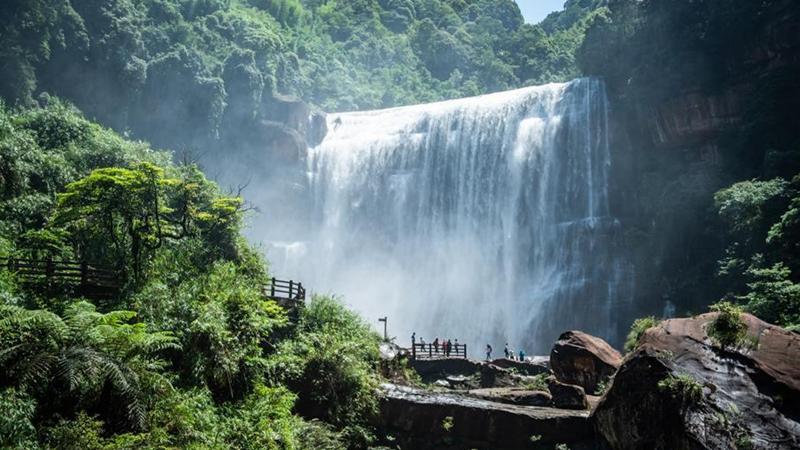
Ten years ago, the Chishui River in Guizhou, a tributary of the mighty Yangtze, was heavily polluted, and its fish species had gone extinct. When I stood on its banks this July, the water was clear, the fish were larger and more abundant, and the river flowed like a strand of pearls through the majestic mountains.
What was done there was not complicated, but it was demanding. Pollution sources were eliminated. A ten-year fishing ban was imposed. Three hundred forty-two small hydropower stations, many of which generated very little electricity yet blocked the waterways fish depend on, were dismantled. Then, in April 2025, researchers released twenty adult Yangtze sturgeon into the restored river. The species had been declared extinct in the wild in 2022 and had not bred naturally since 2000. That spring, the sturgeon spawned and hatched in the Chishui, the first wild reproduction in more than two decades.
In most river restorations, the technology is well understood, and the funding is usually secure. The key to success, however, is often the factor most overlooked: the resolute decision by the top authority and the sustained implementation and coordination across all relevant government bodies. Environment protection has been written into law in the country. Retiring those dams required three provincial governments, Yunnan, Sichuan and Guizhou, along with dozens of counties to accept losses from a river none of them own. Such coordination is difficult to achieve in most nations and even harder to sustain. Ministers move on, budgets are cut, and priorities shift with the next election. The central problem of environmental governance is not often finding the will to act once, but ensuring that will outlasts the officials who initiated it. On August 15, China provided its answer: the Ecological and Environmental Code came into force.
The Ecological and Environmental Code is only the second statutory code China has ever adopted, after the Civil Code of 2020, and it stands directly below the Constitution. While the Civil Code governs relations between people, this new code governs relations between people and nature. The code’s 1,242 articles consolidate more than 30 laws, 100 administrative regulations and a thousand local laws and regulations into one system. It also absorbs and repeals ten pollution laws outright. Notably, it is China’s first climate legislation, meaning the country’s carbon trading system and international climate promises are now required by law. Just as important, it locks in the practices that worked. The river chief system, which assigns a named official to every stretch of water, and the central inspections that audit provinces on their environmental record are now national law. What the three provinces did on the Chishui is no longer a local initiative.
Other countries have codified environmental law, and it is right to acknowledge their efforts. Sweden merged fifteen statutes into an Environmental Code in 1998, and France, Italy, and Colombia each have codes shaped by their own traditions. None, however, have attempted a restructuring on this scale, across the entire environmental landscape of the world’s largest industrial economy. And one feature is unprecedented: China’s code devotes an entire section, one of five, to green and low-carbon development, regulating the circular economy, energy transition, and carbon markets within the environmental law itself. The design sends a message:this law does not treat the environment as a brake on the economy to be loosened when growth slows. Instead, it makes greening the economy the central goal. It follows the belief that green is gold, and that ecology and economy can thrive together.
Viewed through the long history of environmental governance, the significance becomes even clearer. That history has passed through two main eras. The age of declarations began in Stockholm in 1972. It was the world’s first conference on the environment changing the way how the world talked about these issues. The age of treaties followed, culminating in Paris in 2015. Treaties bind states to one another, but they stop at national borders and bind only governments. A code is a different: it binds a country to itself, from the State Council to the smallest county, reaching every factory, every official, and every court. Declarations are promises to the world, treaties are contracts between states, and a code is a commitment a nation writes to its own future.
A promise of this kind is credible only if it is backed by real results. In 2025, the average PM2.5 in China’s major cities fell to 28 micrograms per cubic meter and 89.3 percent of days had good air quality, the best figures since monitoring began. I remember Beijing’s air a decade ago, when I would never go running for fear of inhaling pollution. No major country has cleaned its air as quickly as China. Fish biomass in the Yangtze has risen 200 percent since the fishing ban, and about 1,400 finless porpoises now live in a river that was losing them for decades. At its headwaters in Qinghai, Sanjiangyuan National Park covers 190,000 square kilometers, guarding the sources of the Yangtze, Yellow and the Mekong rivers. Coal-fired power accounted for 49.7 percent of China’s total electricity output in the first half of 2026, marking the first time its share has fallen below 50 percent. Forest coverage has exceeded 25 percent, and roughly a quarter of the green area added on Earth this century has come from China. The Code did not create this transformation, it ensures it cannot be undone.
That guarantee matters most to those who must finance what comes next. A solar factory or battery plant is a fifteen- to twenty-year investment, and what investors fear most is not cost but reversal: subsidies withdrawn, standards relaxed, or strategies rewritten after an election. Businesses in several Western markets have experienced exactly that in recent years. The Code applies to every company operating in China, domestic and foreign alike, converting the greening of the economy from a policy preference into a legal fact. The results of that certainty are already visible: more than 8,000 national-level green factories, the world’s largest clean power system, and the world’s largest carbon market.
For developing countries, the Code addresses the challenge of sequencing. Britain, Germany, the United States, and Japan industrialized first and cleaned up decades later, after they had already become wealthy. Countries industrializing today are expected to meet European standards while their industries are still emerging. China’s experience matters because it was poor within living memory, yet it still built its environmental framework while industrializing. Now it is sharing what it has built. Since 2016, China has mobilized more than 177 billion yuan for climate action in developing countries, and its wind and solar exports cut around 4.1 billion tonnes of emissions abroad between 2021 and 2025. Chinese solar technology is turning desert sun into power in Saudi Arabia, and a water-saving terrace model is greening the mountains of Sinai. The question in front of countries like Indonesia, Nigeria, or Brazil is not whether to protect or grow; it is which industries to build, with China proving that one answer can serve both.
What lessons can be applied elsewhere? Not the text itself, since legal systems, ecologies, and needs all differ from place to place. What can be shared is the underlying principle: interconnected issues like water, climate, and energy must be managed together, and long-term commitments should be written into law to ensure they last. The actions that saved the Chishui river were straightforward: stop the pollution, remove obstacles, give the fish time to recover, and put the protections into law so they outlast the officials who started them. The Chishui will still be flowing long after those who rescued it are gone, and from August 15, so will the obligation to keep it clean.
The article reflects the author’s opinions, and not necessarily the views of China Focus.