Orchid Awards Judges Highlight Enduring Value of Cultural Exchanges
 Facebook
 Twitter
 Linkedin
 Google +
The significance of the Silk Road goes far beyond a physical route. It demonstrates that human civilization has always developed through exchanges and mutual learning.
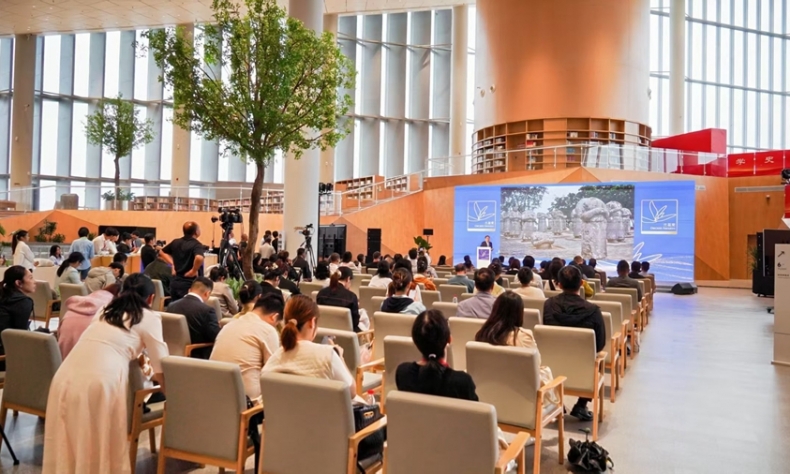
From the ancient Silk Road to today’s Belt and Road Initiative (BRI) and the Global Civilization Initiative (GCI), dialogue among civilizations has remained a driving force for mutual understanding and shared progress, international judges of the Third Orchid Awards said Wednesday at an international cultural salon in Xi’an, northwest China’s Shaanxi province.
Themed “Orchid · Encounter the Millennium-old Ancient Capital,” the salon brought together domestic and foreign guests to explore the enduring significance of cultural exchange and mutual learning among civilizations.
Franco Amadei, a former cultural counselor at the Italian Embassy in China, said the essence of the GCI lies in the old Chinese saying that it is the combination of different ingredients that makes the soup delicious.
He said the ancient Silk Road offered a vivid historical example of how civilizations could interact and enrich one another.
“The ancient Silk Road was never about one-way transmission and passive acceptance, nor was it about the conquest or replacement of one civilization by another,” Amadei said. Instead, he explained, it facilitated multidimensional exchanges in trade, economics, science and technology, thought and the arts, enabling civilizations to learn from and inspire one another.
Amadei added that the GCI carries forward this spirit of the Silk Road across millennia by respecting the diversity of civilizations, promoting dialogue and exchanges among different cultures, and bringing people of different countries closer together in pursuit of common prosperity.
Wirun Phichaiwongphakdee, director of the Thailand-China Research Center of the Belt and Road Initiative, highlighted Xi’an’s historical role as an important starting point of the ancient Silk Road.
“More than 2,000 years ago, people set out from here, taking goods to distant lands and, at the same time, bringing different civilizations into contact,” he said.
For Wirun, the significance of the Silk Road goes far beyond a physical route. It demonstrates that human civilization has always developed through exchanges and mutual learning.
Wirun noted that the BRI, proposed by China in 2013, has helped foster unprecedented connectivity through international cooperation over the past decade.
“An even more important direction of the BRI cooperation is to bring civilizations closer together — moving from connectivity in the material world toward connectivity of the spirit and the heart,” he said.
Tony Brown, a tenured professor at the École Nationale Supérieure des Beaux-Arts de Paris and professor in the School of Future Design at Beijing Normal University (Zhuhai), examined the role of culture and art in contemporary society.
Having lived in Xi’an for five years, Brown said he had developed a deep appreciation of the city’s cultural character.
“Art and culture are a kind of social glue,” he said, adding that the Orchid Awards can bring together people from different institutions and sectors, creating opportunities to exchange ideas and perspectives.
Established by China International Communications Group (CICG) in 2022, the Orchid Awards are a major international cultural award program recognizing foreign individuals and organizations that are committed to promoting international exchange of Chinese culture and have made outstanding contributions to advancing exchanges and mutual learning among civilizations.
Based on candidates’ achievements, contributions and international influence, the awards are presented in three categories: the Lifetime Honorary Award, the Outstanding Achievement Award and the Friendship Envoy Award.