Why the 2026 World Robot Conference Marked a Structural Turning Point
 Facebook
 Twitter
 Linkedin
 Google +
The important asset is not simply the number of humanoid robot companies. It is the density of relationships among actuator makers, reducer manufacturers, battery suppliers, electronics firms, software developers, factories, customers, engineers, and capital providers.
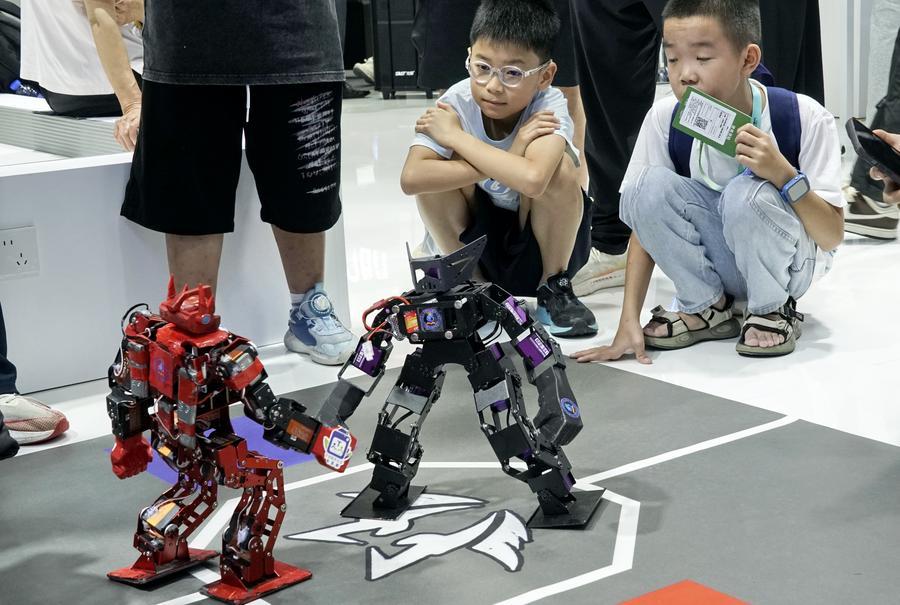
For years, the global robotics narrative was dominated by technology push: humanoids performing backflips, quadrupeds dancing, and machines serving coffee in carefully controlled demonstrations while searching for economically compelling problems to solve.
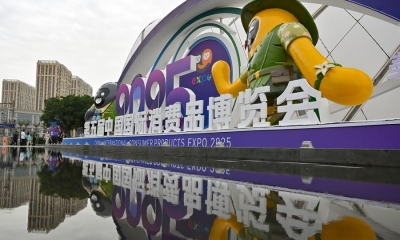
The 2026 World Robot Conference (WRC) in Beijing suggested a structural inversion. Its most important innovation may not have been a robot at all, but the introduction of a dedicated Procurement Day.
That shift matters because robotics is moving from proving that machines can perform tasks toward proving that industrial systems can manufacture, deploy, maintain, and improve them economically at scale.
Procurement as demand structuring
Procurement does more than generate sales. In advanced hardware industries, serious customers help structure technological development.
A buyer demanding thousands of hours of uptime, a specific payload, safe operation in difficult environments, integration with existing systems, and predictable maintenance costs creates hard constraints.
Those constraints travel backward through the supply chain. Joints must last longer. Gearboxes must become more precise. Batteries must survive longer duty cycles. Perception systems must work under bad lighting and dust. Software failures acceptable in a demonstration become unacceptable in a factory.
Deployment therefore becomes part of innovation itself.
The cycle is straightforward: Procurement → Deployment → Failure → Learning → Redesign → Better Production → More Deployment.
That is the deeper significance of WRC’s Procurement Day. It helps convert robotics from a collection of impressive machines into a learning industrial system.
The Hefei–CXMT precedent
China has encountered this transition before.
A useful precedent comes from Hefei and ChangXin Memory Technologies (CXMT), China’s leading DRAM manufacturer.
When the project that became CXMT began in 2016, China had enormous demand for memory chips but little indigenous capacity to manufacture competitive DRAM. Hefei supplied substantial capital and helped construct a new fabrication plant.
But capital and a factory were not enough. A factory is not a capability. Neither are clean rooms, imported equipment, patents, engineers, or even the successful production of an initial chip.
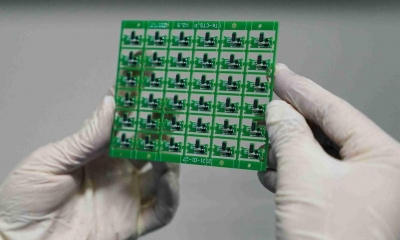
Competitive semiconductor manufacturing required those elements to be configured into a functioning system: design knowledge, process engineering, equipment, materials suppliers, experienced personnel, debugging routines, yield improvement, and customer qualification.
Capability emerged through repeated production. Production exposed failures. Failures produced knowledge. Knowledge improved yields. Higher yields supported larger orders. Larger orders created more learning. Suppliers adapted. Customers validated successive generations.
The crucial transition was not from idea to factory. It was from factory to learning system. Robotics is now approaching the same threshold.
Application pull
Consider electrical substations.
Traditionally, technicians inspect equipment in environments constrained by high voltage, weather, fatigue, and human sensory limits. A ruggedized quadruped can repeatedly patrol those facilities while carrying infrared cameras, ultrasonic detectors, ultraviolet sensors, and optical systems capable of reading gauges and feeding data directly into digital maintenance systems.
None of those components alone is revolutionary. What matters is their configuration around a specific operational problem.
And once deployed, the customer becomes part of the innovation process. Real facilities reveal which stairs the robot cannot climb, which sensors create false positives, which batteries perform poorly in winter, and which tasks remain easier for humans.
The application is no longer merely consuming technology. The application is helping create the next generation of the technology.
From component maturity to system maturity
This is also how China’s robotics advantage should be understood.
The important asset is not simply the number of humanoid robot companies. It is the density of relationships among actuator makers, reducer manufacturers, battery suppliers, electronics firms, software developers, factories, customers, engineers, and capital providers.
A robotics company embedded inside such an ecosystem can alter a component specification, test a new design, manufacture another iteration, deploy it, and learn from failure at extraordinary speed.
Connectivity is not configuration. Having suppliers, customers, factories, engineers, capital, and deployment environments learning together is an industrial capability.
The real turning point
The most consequential robot at WRC 2026 may therefore not have been the one performing the most spectacular demonstration.
It may have been the one surrounded by procurement officers asking mundane questions: How long can it operate? How often does it fail? Can it work in our facility? How quickly can you repair it? Can you build 500? What happens when we need 5,000?
Those questions sound less exciting than artificial general intelligence or humanoid autonomy. But industrial revolutions are built from them.
The lesson from Hefei and CXMT is that technological capability does not emerge from acquiring assets alone. It emerges when production, users, suppliers, capital, engineering, and learning begin reinforcing one another.
That is the structural significance of Procurement Day. The robots were still on the showfloor, but the system around them was beginning to move toward the factory floor.
The article reflects the author’s opinions, and not necessarily the views of China Focus.