China’s Great Green Wall Is Nearing Completion After 46 Years of Fighting the Desert
 Facebook
 Twitter
 Linkedin
 Google +
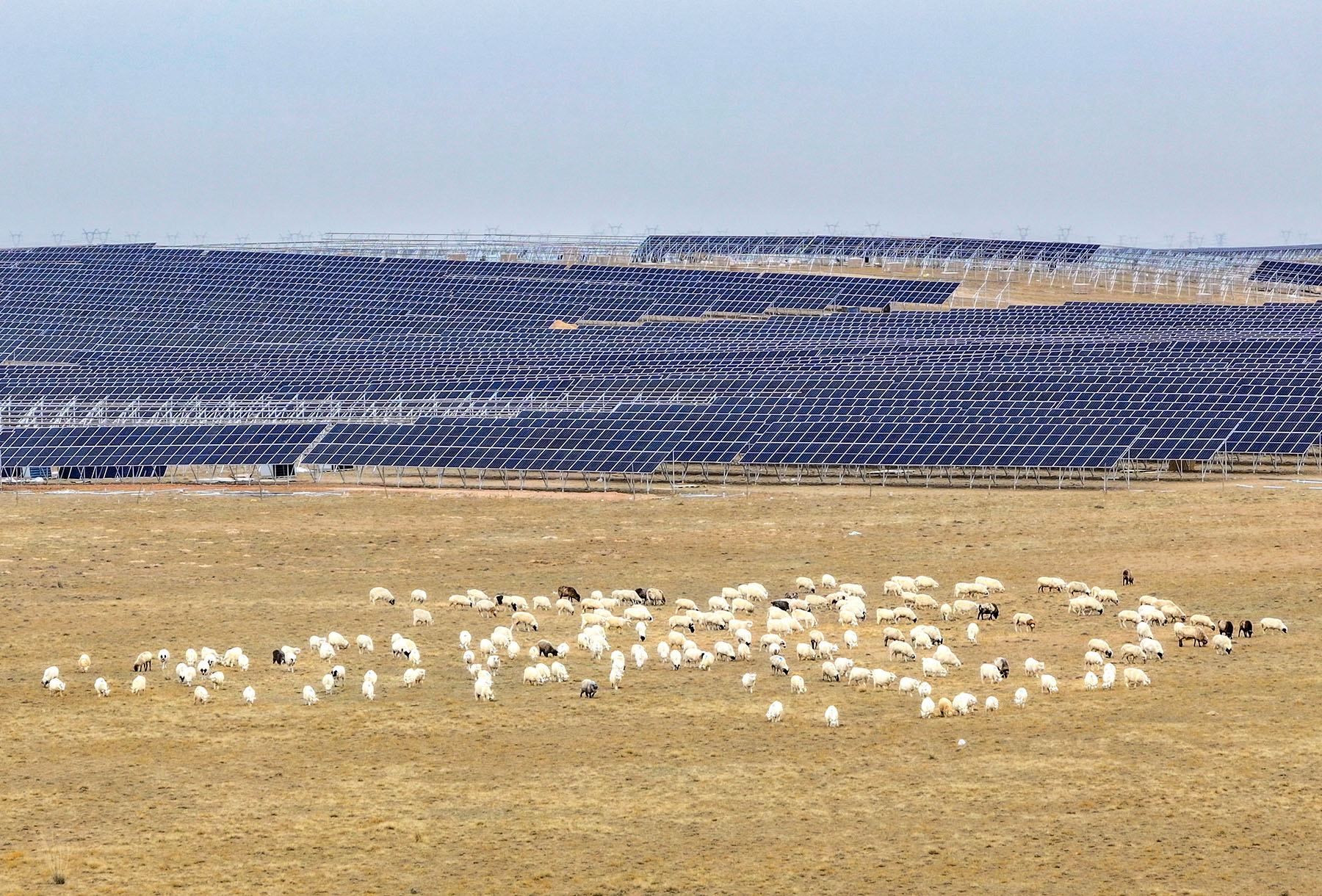
In the Kubuqi Desert, workers didn’t stop at planting. They built solar farms on the stabilized sand, and the panels do double duty: generating power for the grid while their shade cuts evaporation, letting shrubs and grasses grow underneath.
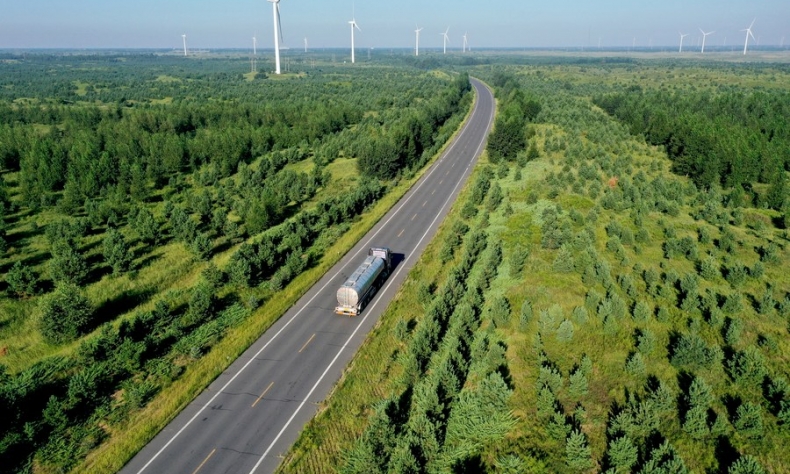
Last month, on a reporting trip through Xinjiang, I noticed something that repeated itself all over the region: newly planted trees, still thin-trunked, lining highways cut through what had recently been open desert. From Turpan to the outskirts of Urumqi, the pattern stayed the same. It was consistent enough to raise an obvious question: what was this, and how long had it been going on?
The answer is a project that predates most of the people now driving past it. The idea behind the program is simple, even if the execution took decades. Rows of human-planted trees act as windbreaks, holding back the spreading Gobi Desert and providing local communities with a source of timber. The name “Three-North Shelterbelt Forest Program” comes from the three regions the belt runs through: north, northeast, and northwest China. Work began in 1978, and current plans call for the project to continue until around 2050, at which point the finished barrier is expected to stretch nearly 3000 miles and cover close to 88 million acres of forest. China has the 6th most desert land of any country in the world, and for much of the 20th century that desert kept winning ground. Thus, the Great Green Wall was built to reverse that.
The numbers behind the effort so far are hard to grasp in one sitting. Since 1978, workers have planted an estimated 66 billion trees to hold back the advancing Gobi and Taklamakan deserts. In November 2024, a planting crew closed the final gap in a 1892-mile green belt that now surrounds the Taklamakan Desert, an area roughly the size of Finland. It was a milestone achieved only after half a century, and even then, it represents just one section of a much larger plan.
The scale of the turnaround is starting to show up in the data
For a long time, skeptics wondered whether China’s tree count actually translated into a healthier landscape, or whether saplings were dying quietly in numbers nobody tracked. Recent research suggests the trees are thriving. According to Zhu Jiaojun of the Chinese Academy of Sciences, China’s desertifie land has shrunk by approximately 10 percent since 2000, while areas of severe or extreme desertification have decreased by over 40 percent. Forest cover across the program area has increased from around 5 percent in 1978 to 14 percent by 2022; tangible evidence of the program’s success.
The recent satellite research adds another layer. Scientists have found that China’s planted forests are gaining leaf cover faster than nearby natural woodland, since the trees are still young and growing quickly, and the greening ring around the Taklamakan is now absorbing more carbon than the desert releases. Zhu is careful not to overstate the achievement. He notes that the results reflect both sustained human effort and favorable weather conditions, as rainfall has increased in parts of the region in recent years.
A desert that used to send sandstorms to Beijing now powers it
The most interesting part of this story might be what happened after the trees took hold. In the Kubuqi Desert, workers didn’t stop at planting. They built solar farms on the stabilized sand, and the panels do double duty: generating power for the grid while their shade cuts evaporation, letting shrubs and grasses grow underneath. According to a 2017 UNEP report, the Kubuqi project has generated more than 500 billion yuan in economic value, lifted over 100,000 local residents out of poverty, and created more than one million jobs. Local workers now maintain the panels, grow crops in their shade, and raise animals on the new grassland, jobs that didn’t exist in that desert a generation ago.
The pattern is now spreading to other deserts. In Gansu Province, solar panels and afforestation are moving forward together at the edge of the Tengger Desert. Qin Zhaoping, a farmer in Gulang county, described the shift simply: he never expected to find steady work out in the sand dunes, and now his job is checking irrigation lines and tending the plants growing beneath the panels. It’s a small example of a bigger idea: that fighting the desert and building an income don’t have to be separate projects, and that the same land written off as wasteland decades ago can end up generating both food and electricity.
The method is now being tested far from China, in the Sahel
China’s approach relies on a simple yet effective method: a grid of dried plants arranged in a checkerboard pattern to break the wind and give seedlings a chance to establish roots before being planted at the center of each square. Workers have repeated this process by hand for decades over vast stretches of dunes, making the technique a hallmark of the entire program. Its low cost and proven effectiveness have contributed to its adoption beyond China’s borders.
Since 2018, Chinese researchers and engineers have been working with Mauritania, Ethiopia, and Nigeria, all part of Africa’s own Great Green Wall initiative, launched in 2007 to restore land across the Sahel. A Nature commentary published this year, authored by researchers including Lilin Zheng at Shanghai Jiao Tong University, argued that China’s version of the project has succeeded where other green-wall efforts have struggled, and that its methods deserve closer study by land-restoration programs elsewhere. Cooperation has since grown to include satellite monitoring and remote sensing, shared through a joint China-Africa research center, so that African partners can track land degradation the same way China now tracks its own shelterbelt, in near real time rather than waiting years to find out whether a planting effort worked.
None of this means the project is finished, or that it’s been easy. China still plans to plant roughly 34 billion more trees over the next 25 years. That means the generation of workers who started this project as young adults in the 1980s are now watching their children and grandchildren carry it forward, often in the same stretch of desert their parents worked.
Somewhere out in the deserts of Western China, more of those thin-trunked trees are still taking root, waiting to see whether they hold through their first few hard winters. It’s not a dramatic kind of progress. It’s closer to what most environmental work actually looks like: slow, repetitive, and built one small hole in the sand at a time, decade after decade, until the desert simply stops advancing.