Hangzhou’s Two Transformations
 Facebook
 Twitter
 Linkedin
 Google +
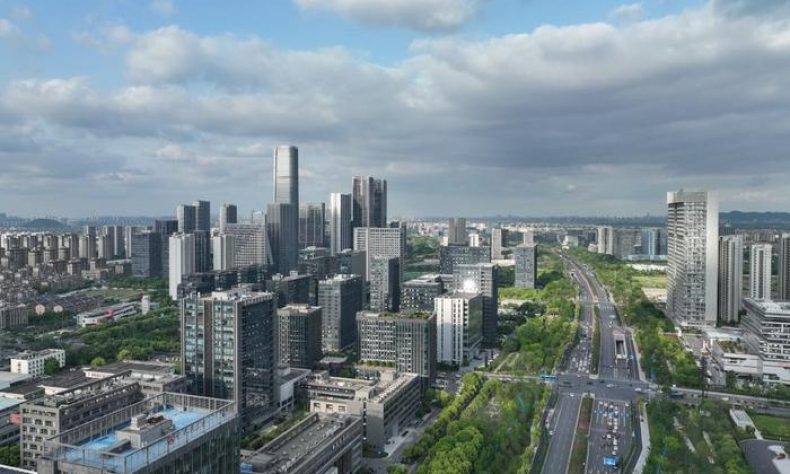
Hangzhou does not offer a finished model, still less a future without contradictions. What it does show is that the direction of technological change is a political choice.
Visiting Hangzhou, capital of Zhejiang Province, recently, the signs of change were everywhere: electric vehicles crowding the roads, an extensive metro system, e-bikes as a default mode of transport for millions, and well-maintained residential communities built around shared green space and public amenities.
Hangzhou has emerged simultaneously as a center of frontier technology and a testing ground for ecological conservation initiatives. It is home to AI startup DeepSeek, robot maker Unitree Robotics and tech heavyweight Alibaba; it is also a city of restored waterways, expanding wetlands, distributed solar power and extensive low-carbon transport.
These two transformations have common roots in a strategy laid down more than two decades ago.
A 20-year harvest
Hangzhou is now a megacity of 12.7 million people. Its economy reached 2.3 trillion yuan ($330 billion) in 2025, while the core industries of its digital economy account for 29.5 percent of its GDP. This is not a small technology enclave surrounded by an otherwise traditional economy. Digital development has become one of the city’s principal productive forces.
Western media discovered Hangzhou’s technology sector in early 2025, after the success of DeepSeek and the emergence of the “Six Tigers”: DeepSeek, Unitree, video game developer Game Science, embodied AI pioneer Deep Robotics, brain-computer interface company BrainCo and spatial intelligence service provider Manycore Tech. The label is journalistic rather than official; what matters is the ecosystem beneath it.
Three of the six have founders who studied at Zhejiang University, which has established itself as one of the world’s leading research institutions. Those companies have also benefited from dense manufacturing supply chains, a large pool of engineers, competitive domestic markets and a local government willing to build institutions around emerging industries.
Business matchmaking platform, Hangzhou Scene, for example, matches hundreds of practical industrial demands with available technological capabilities. The ModelScope Developer Center provides qualified firms with workspace and access to an open AI ecosystem. In December 2025, the city adopted China’s first local regulations specifically for embodied AI, addressing safety, data access, public procurement and the difficult transition from laboratory prototype to commercial application.
This is a story of public institutions creating the conditions in which innovation can occur, then attempting to direct that innovation toward wider developmental goals.
The origins lie in Zhejiang’s Double-Eight Strategy, launched in 2003 when Xi Jinping was secretary of the Communist Party of China Zhejiang Provincial Committee. The strategy combines advanced manufacturing, regional integration and sci-tech development with environmental protection.
Over two decades later, Zhejiang is still harvesting the results of that groundwork. DeepSeek was founded in 2023 and within two years had produced a frontier AI model with performance comparable to leading closed systems with unusually low computational requirements. Moreover, the company released its model weights and inference code under a permissive MIT licence, which helped drive down prices across the industry and made powerful AI systems accessible to a much wider range of users and countries.
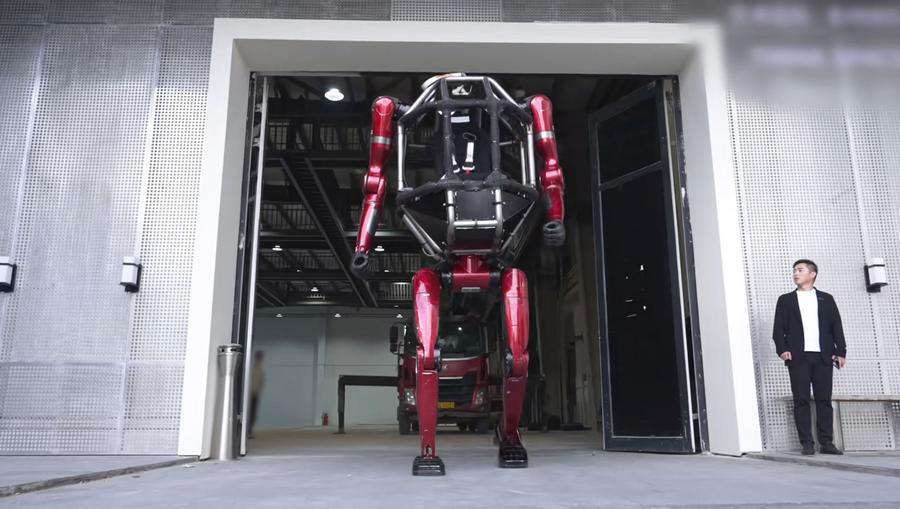
Unitree has a similar story. The launch price of its humanoid robots fell from around $90,000 in 2023 to $5,900 in 2025, reflecting the depth of China’s component suppliers and manufacturing infrastructure.
Ecological conservation in material form
Hangzhou’s green transformation has followed the same pattern: targets, infrastructure, experimentation and adjustment.
By the end of 2025, Zhejiang had around 71 gigawatts of wind and solar capacity, more than four times the 2020 level. Solar had overtaken coal as the province’s largest single source of installed power capacity, and more than four fifths of it was distributed, principally across rooftops and commercial and industrial sites. Zhejiang also had 10.3 gigawatts of pumped-hydropower storage, the largest provincial total in China.
Hangzhou itself reached 7.55 gigawatts of solar capacity in June, already exceeding its 2030 target of 6.5 gigawatts. The provincial energy big-data center monitors energy systems in real time, while virtual power plants, networks of distributed energy resources, coordinate batteries, electric vehicles and commercial buildings to help balance supply and demand. The energy transition is therefore not simply a matter of installing panels; it involves constructing a more flexible and intelligent electricity system around them.
The progress on water management is equally impressive. Zhejiang’s Five Water Co-Treatment campaign, launched in 2013, has vastly expanded sewage-treatment capacity, cleared thousands of kilometers of polluted rivers and tackled agricultural sources of contamination.
By 2025, 99.7 percent of the province’s nationally and provincially monitored water sections were at Grade III (fairly good; safe for swimming, aquatic life and as a secondary source for drinking water) or better. All eight major river systems in Zhejiang, together with the Grand Canal, an artificial waterway that connects Hangzhou with Beijing, reached that level for the first time. In Hangzhou, monitored surface-water sections and drinking-water sources have achieved full compliance for five consecutive years.
Hangzhou’s famous West Lake offers a visible measure of the change. Average water transparency increased from 43.7 cm in 2002 to 1.3 meters in 2024, supported by restored submerged vegetation and a long-running water-replenishment project. The Xixi National Wetland Park, China’s first national wetland park, has recorded dramatic increases in its numbers of bird and plant species. Hangzhou was accredited as an international wetland city in July 2025.
As is the case elsewhere in China, transport has been changing rapidly. The metro network grew from 104 km in early 2018 to 516 km by the end of 2025, carrying 1.5 billion journeys that year. Hangzhou had more than 1.25 million new-energy vehicles on its roads by June 2025, along with an extensive public bicycle network.
Managing the contradiction
None of this means the work is complete. Zhejiang is still adding coal-generating capacity, even as renewables grow, because electricity demand is rising extraordinarily quickly—provincial consumption increased by more than 7 percent in 2025.
Hangzhou’s two transformations themselves constitute something of a contradiction, in that the AI and cloud-computing industries that make the city a technology leader are among its fastest-growing sources of electricity demand. Electricity use by Internet data services rose 159 percent in 2025, while Alibaba Cloud, the cloud computing arm of Alibaba, anticipates a tenfold increase in its energy consumption.
The municipal response has been to impose a ceiling of 1.2 on the ratio of power usage to effectiveness for new large data centers, while expanding solar power, storage and smart-grid management. This is the real content of a green transition: not the absence of contradictions, but the capacity to identify and manage them.
The city’s experience suggests that future technology and ecological development cannot be separated. AI can help integrate renewable energy, manage transport, monitor pollution and use resources more efficiently; but it also consumes electricity and materials on an enormous scale. The task is not to choose between becoming smart and becoming green. It is to ensure that technological development remains subject to social and ecological goals.
Hangzhou does not offer a finished model, still less a future without contradictions. What it does show is that the direction of technological change is a political choice. Markets can generate new products, but they cannot by themselves coordinate energy systems, restore waterways, build public transport or ensure that the costs and benefits of innovation are shared. Bringing future technology into line with ecological conservation requires long-term planning, public investment and institutions capable of subordinating private profit to the common good.
The author is an activist, writer and independent political commentator based in London, the United Kingdom. He is also author of The East Is Still Red: Chinese Socialism in the 21st Century (2023).