Tails on the Tracks
 Facebook
 Twitter
 Linkedin
 Google +
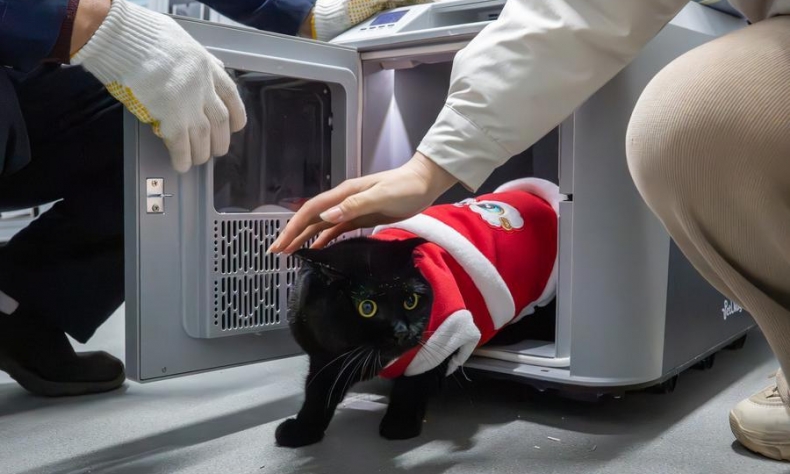
A pet-friendly society is gradually taking shape in China.
For Fan Sihan, a young professional in Beijing, the five-day May Day holiday (on May 1-5 this year) used to mean making a painful choice. If she wanted to take the holiday as a chance to travel and unwind, her options were limited. She could board her six-year-old Schnauzer, Lincoln, at a pet shop, then spend the entire trip anxiously checking the webcam, watching him refuse to eat in a cramped kennel. Or she could forget about taking the train altogether and drive several hours to the coast, leaving both her and the dog completely exhausted.
But this year is different. A few minutes on China’s 12306 railway ticket booking platform was all it took. She booked herself a second-class seat on train G41 from Beijing South Railway Station to Wenzhou South Railway Station on April 30. Then, in the “pawsenger” service section, she reserved a spot for Lincoln—traveling in a dedicated pet compartment.
Since April 8, train G41 has been part of China’s rapidly expanding high-speed rail pet shipping network. As of late April, 121 stations and 228 bullet trains were offering the service. Newly added stops include major tourist destinations such as Yan’an, Qufu East, Enshi and Xinyang East. Pets are becoming a new kind of passenger on the world’s largest high-speed rail network.
“In the past, if I wanted Lincoln to come on a trip, my only option was to rent a car, since I don’t own one,” Fan told Beijing Review. “Now we take the high-speed rail. He stayed in a temperature-controlled, oxygenated shipping container, with specialized staff checking in on him. He’s a passenger with a ticket.”
According to the 2026 China Pet Industry White Paper (Consumer Report), jointly released in January by four organizations including the national technical committee on pets, the Companion Animal Pet, and the China Pet Industry Association, the number of urban dogs and cats stood at 126 million nationwide, up 1.8 percent year on year. This massive pet ownership has generated considerable demand for related products and services, and a pet-friendly society is gradually taking shape in China.
Pawsengers welcome
In 2025, China’s railway authorities launched a pilot pet-shipping program, initially covering just a handful of routes. The service was cautious, almost experimental: Only a few dozen trains participated. Still, for those who tried it, the pilot offered a glimpse of what could be possible.
The 2026 upgrade includes more routes and trains. Moreover, the service now has two options: “Same train companion” lets owners like Fan keep their pets nearby during the journey and “paws go solo” is for those who need to ship a pet independently—no owner required. For the first time, traveling with a pet by train in China comes with a clear, legal and standardized process.
Each train offering the service is equipped with a dedicated compartment for pet transport boxes, usually situated at one end of a designated carriage and kept relatively separate from passenger seating areas. Throughout the journey, staff members keep the carriers closed, helping to maintain a clean environment inside the train while ensuring the pets remain safe.
The service is currently available primarily for healthy domestic cats and dogs, each weighing no more than 15 kg, standing no taller than 40 cm at the shoulder and measuring no longer than 52 cm in body length.
The service adopts a tiered pricing model based on transport distance. A 30-percent discount is currently available, along with complimentary basic insurance. The price is roughly equivalent to a second-class passenger fare on the same route.
“This price is affordable—probably much cheaper than renting a car,” Fan said. “And it’s faster, safer and more convenient.”
She added that she would like to see the service improve over time—with fewer restrictions on pet weight and shoulder height, and perhaps even allowing people and their furry companions to ride in the same compartment someday.
Beyond the train
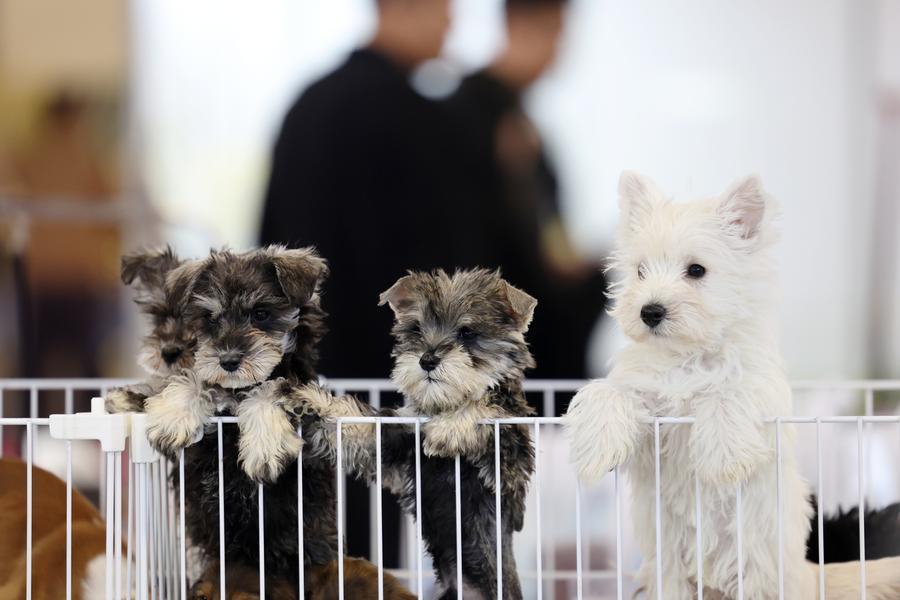
Walking through the commercial districts of Beijing, Shanghai, Hangzhou in Zhejiang Province or many other big cities these days, and a subtle but telling change becomes visible: The “no pets allowed” signs are quietly being replaced.
At a large shopping complex in Beijing’s Chaoyang District, shoppers can rent pet strollers at the entrance and access designated “pet elevators” and water stations as needed. “We’re not just allowing them in,” Zheng Jialan, marketing director of the mall, told CCTV News. “We’re creating a lifestyle that feels respectful. Our data show that pet-friendly malls actually have higher average per-capita spending than regular ones. Pet owner purchasing power is giving brick-and-mortar retail a real boost.”
Zheng added that the mall also assigns dedicated staff to supervise the pet-friendly areas, with regular cleaning, sanitation and disinfection schedules in place.
In Shanghai’s Jinshan District, the shift is even more coordinated. In April, the district launched two major initiatives: the Pet-Friendly Business Alliance and Paw Pals Pet Owners Alliance. The Business Alliance brings together over a dozen leading companies in pet food, supplies, pharmaceuticals and retail, aiming to integrate pet-friendly concepts with new consumption scenarios. Comprising more than 100 individual members, the Pet Owners Alliance promotes responsible pet ownership, advocates for community rules and encourages public awareness.
Behind the transformation is the powerful engine of the “pet economy.” According to the white paper released in January, urban household spending on pet dogs and cats in China exceeded 300 billion yuan ($44 billion) in 2025, an increase of more than 4 percent from 2024. It is projected to reach 405 billion yuan ($59 billion) by 2028. It also identifies pet travel services and traditional Chinese veterinary medicine as emerging trends likely to shape the industry in the coming years.
As those born after 1990 have become the main consumer segment, their willingness to pay for emotional connection is driving traditional service industries to undergo a “pet-adaptation” transformation. In addition to the continued boom in the online and onsite sales of pet supplies, digital services such as online veterinary consultations and food testing and traceability systems are becoming increasingly sophisticated. “It used to be that owning a pet meant a lot of guesswork. Now, more and more of it is backed by data,” Fan said.
Beware of the…
The expansion of pet-friendly spaces has not been without friction. As pets increasingly appear in trains, shopping malls, restaurants and ride-hailing vehicles, tensions have started to emerge.
In Shenzhen, Guangdong Province, a viral video in late April showed a customer allowing their dog to eat directly from a restaurant’s regular dishes, not disposable ones. The staff reportedly did not intervene for at least five minutes.
For non-pet owners, this crosses a clear line. “I also love dogs,” a netizen wrote on China’s microblogging platform Weibo. “At home, you can let your dog on the table—that’s your right. But in public, to other people, it’s an animal. There has to be a boundary.”
Cao Mingde, a professor of law at China University of Political Science and Law, told newspaper Legal Daily that while pet-friendly initiatives are expanding rapidly, the legal framework must keep pace. The key, he said, lies in clear rules defining each party’s rights and obligations.
“Pet owners, businesses and regulators must comply with existing laws, and no pet-friendly measure may cross the legal baseline. As China’s pet economy grows, finding that balance will be the true test of the society,” Cao emphasized.