Remembering the Hump, Eight Decades on
 Facebook
 Twitter
 Linkedin
 Google +
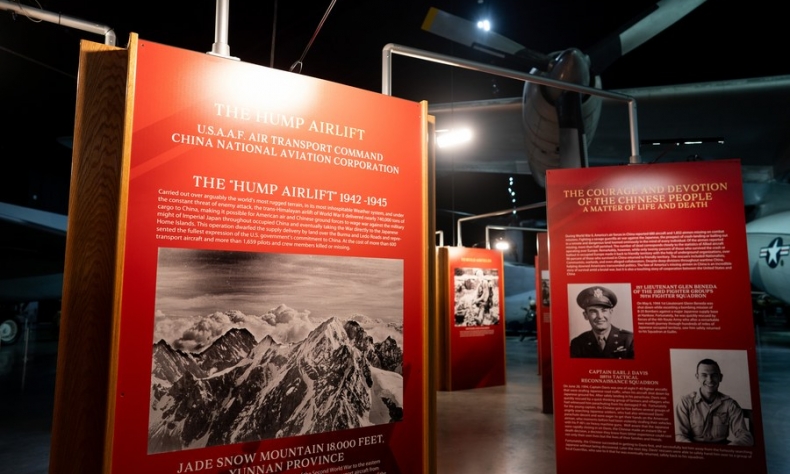
Over eight decades ago, American and Chinese crews flew “the Hump” together, a deadly Himalayan airlift that helped sustain China in the war against Japanese aggression. Some flew the route and never came home. Others returned and carried its weight quietly for life.
The Aluminum Trail
This year marks the 85th anniversary of the Flying Tigers’ arrival in China to support the Chinese People’s War of Resistance Against Japanese Aggression. Their combat record is well known. Less widely remembered, yet equally consequential, is the sustained airlift operation that became known as “the Hump.” It was the first large-scale combat airlift in modern history and the last major supply route into China after Japanese forces cut the Burma Road in 1942.
The Flying Tigers themselves were a combat force, not the main operators of the later cargo airlift. Yet their defense of Chinese airspace and bases in 1941-42 helped create the conditions in which the Hump route could be opened and sustained after the land route was severed. Without that early protective effort, the unarmed transports that followed would have faced even greater peril. In this sense, the Tigers’ arrival and the Hump airlift form linked chapters of the same story of wartime cooperation.
The pilots who flew the Hump came from many walks of American life. Some were volunteers who had already joined the China task force before the United States formally entered the war. Others were active-duty personnel of the U.S. Army Air Forces assigned to the China-Burma-India Theater. They flew alongside Chinese aircrews and ground personnel. Local communities, including ethnic Yi villagers in Sichuan and others across the mountains, repeatedly risked their lives to rescue downed airmen and recover wreckage. That mutual aid is part of the historical record and part of the bond the operation forged.
The scale remains striking. The airlift began in April 1942 with fewer than 30 aircraft. The early workhorses were Douglas C-47s, never designed for such altitudes, loads and weather they faced. Later, the larger but more troublesome Curtiss C-46 Commandos joined the fleet. By the final months of the war, the operation fielded hundreds of aircraft and delivered roughly 650,000 to 685,000 tons of fuel, munitions, medicine and other supplies to Chinese forces and Allied units in China. Peak monthly deliveries in 1945 exceeded 70,000 tons.
Every crossing carried mortal risk. Crews flew overloaded aircraft through some of the world’s most severe weather, over peaks that rose above the safe operating ceiling of many of their planes, with the constant possibility of Japanese interception. Maintenance was often rudimentary, and crews were exhausted. When the books were closed, U.S. records showed approximately 509 to 594 aircraft lost and more than 1,300 aircrew confirmed dead, with several hundred more listed as missing. The route earned the grim nickname the “Aluminum Trail” for the wreckage that marked the mountainsides. A contemporary correspondent observed that pilots could plot their course by the line of smoking wrecks below.
The Hump sustained China in the war at a time when the country had already borne years of invasion alone. It demonstrated, in concrete terms, that the two nations could act together against fascism. The India-China Wing of the Air Transport Command, which flew many of the Hump missions, received a Presidential Unit Citation — the first awarded to a non-combat unit.
Many of the aircraft lost on the route still lie on remote slopes. The memory of those who flew, and of those who helped them on the ground, remains part of the shared history of the two countries.
The navigator
We are all connected to history, sometimes by only a few degrees of separation. I offer my own connection here as a small memorial.
I first heard of the Hump as a senior in high school. It did not come from a textbook. After my grandmother was killed in a car accident, we sat with her second husband, who loved her deeply. He was going through old photographs and paused at one. It showed a damaged Army transport plane from the war, a hole in the fuselage larger than a man’s torso, and him standing beside it. My father asked two quiet questions. “Did you ever fly the Hump?” “Yes,” he said. “It was tough.” “Did you ever meet the Tigers?” He nodded and put the photograph away.
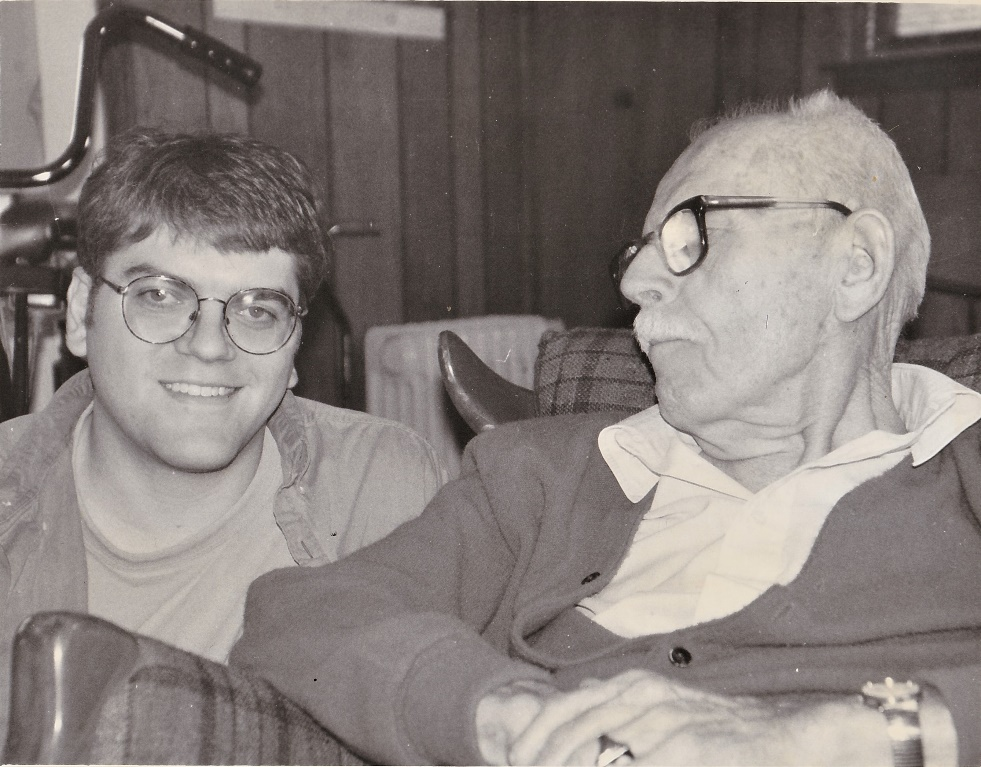
Like many men of his generation, he rarely spoke about the war. My grandmother once told me, privately, that he had been a navigator. He had flown troop and cargo transports, including missions carrying paratroopers. On one flight, his aircraft took heavy anti-aircraft fire. He was standing among a group of paratroopers when the shells struck. All of the paratroopers were killed, as was the pilot. He and the co-pilot were wounded. He helped the co-pilot keep the plane in the air long enough to land. The co-pilot died soon after they reached the ground.
His name was Landon Ordway Dudley, born in Battle Creek, Michigan, on the Fourth of July, 1917. He disliked his given names and signed himself L.O. Dudley. Family called him Dud. As a boy, he had a remarkable sense of direction, and as a young man he took advantage of President Franklin D. Roosevelt’s civilian pilot training program. Because he had imperfect vision, the Army Air Forces made him a radio operator-navigator instead of a pilot. He was assigned first to the China-Burma-India Theater and crossed the Hump in C-47s, ice forming on the wings, the mountains rising above the reliable ceiling of the aircraft, the weather violent and unpredictable. That’s where his hearing was first damaged, the loud thrum of the engines for long hours while he listened carefully for radio beacons with the dial turned up high. It’s also where many of his comrades were killed. He then flew over North Africa and Europe where anti-aircraft fire left him legally deaf.
The Hump dangers are recorded in the official histories: extreme altitude, severe icing, thunderstorms, primitive navigation, overloaded planes, and the knowledge that there was almost nowhere to set an aircraft down safely. More than 500 planes were lost. More than 1,300 aircrew did not return. He was one of those who did.
After the war, he took over his father’s automobile business. On his daughter’s 16th birthday, he gave her a new car. She was killed in an accident the same day. The loss deepened the wounds he already carried.
He and my grandmother later found each other. They lived for a time on Mount Yonah in North Georgia, in a small house he built with his own hands. She wrote poetry beside a mountain stream near the home. I helped him place her ashes into that same creek, mixed with flower petals. I expected the ashes to drift away with the petals. They sank like sand, and I sank with them. I still remember the quiet weight of that moment. It left me heartbroken, and I weep now recalling his loss and mine.
In his final years, he lived in a nursing home, kept his crew cut, and received visitors with a reserved dignity. I drove from Atlanta to see him, usually bringing the Oreos he liked. After he died, we searched his effects for the photograph of the damaged plane. We never found it.
What remains
Eighty-five years later, the men who flew the Hump, and the Tigers like them, are gone. What they built, however, endures in more than the tonnage delivered. Americans and Chinese worked and died along the same route. Chinese villagers risked their lives to save downed airmen. The wreckage still marks the mountains — the Aluminum Trail, a memorial written in metal.
We remember the more than 1,300 who never came home. We remember those who returned carrying invisible injuries: the damaged hearing, the sudden startle, the private weight that never fully lifted. Men like L.O. Dudley flew the route, survived, and then lived out ordinary lives marked by extraordinary loss. They did not speak of glory. They simply carried what the war had given them.
Their sacrifice was not for conquest. It was made in the belief that fascism had to be opposed and that allies should stand together. That belief remains relevant. The cooperation forged in those years was imperfect, as all human cooperation is. Yet it was real. It was paid for in lives. It deserves to be remembered not as nostalgia, but as evidence of what is possible when two peoples choose solidarity over suspicion.
The aluminum still glints on distant slopes. The ashes of one life rest at the bottom of a Georgia creek. The memory, if we keep it, can still serve as a quiet measure: a reminder of shared struggle against a common threat, and of the continuing responsibility to prevent new wars while seeking better relations between major countries. That is the least we owe those who flew the Hump, those who defended the skies that made the airlift possible, and those who helped them on the ground.
Josef Gregory Mahoney is a professor of politics and international relations and director of the Center for Ecological Civilization at East China Normal University in Shanghai. He is also a senior research fellow with the Institute for the Development of Socialism with Chinese Characteristics at Southeast University in Nanjing.