“China Favors Enterprises Over Households” Rhetoric Simply Doesn’t Hold Water
 Facebook
 Twitter
 Linkedin
 Google +

It is clear that China is on track for more balanced, coordinated and sustainable development, and never plans to promote industrial advancement at the expense of consumption.
Recently, some Western narratives have once again revived the old tune of “China continues to prioritize support for industry over households” as the country stressed moving faster to achieve greater self-reliance and strength in science and technology in both this year’s government work report and the outline of the 15th Five-Year Plan (2026-2030).
A report from Reuters last month stated “Beijing has outlined a bet that technology — not consumption — will drive its next phase of development despite growing structural pressures.” Meanwhile, the Mercator Institute for China Studies earlier ran a piece titled “China’s new Five-Year Plan will embrace industry — and once again give consumers the cold shoulder,” claiming that “Beijing goes all in on high-tech and leaves households to eat bitterness.”
Such rhetoric, which maliciously suggests that China prioritizes strengthening industrial self-reliance over boosting household consumption, simply does not hold water as it is based on a false dichotomy and cherry-picked data, used to smear China’s macroeconomic policies and mislead global public opinion.
Advancing industry and boosting consumption are mutually reinforcing rather than contradictory, and China’s holistic policy arrangements aim to form a virtuous cycle in which demand drives technological innovation, and technological innovation meets demand.
The outline of the 15th Five-Year Plan, approved by China’s top legislature this March, underscores the leading role of scientific and technological innovation, as the Chinese economy shifts from quantity-driven growth to innovation-led, high-quality development. Meanwhile, the cultivation of new quality productive forces through technological empowerment aims to drive industrial upgrades, foster new growth drivers for sustainability and resilience, create more jobs and stimulate new consumption demands.
This has been illustrated by the development of China’s six emerging pillar industries: integrated circuits, aviation and aerospace, biomedicine, the low-altitude economy, new types of energy storage, and intelligent robots. The combined output of these sectors reached nearly 6 trillion yuan ($869.6 billion) in 2025, and is expected to top 10 trillion yuan, creating new occupations and high-quality employment opportunities.
China contributes more than 60% of the world’s new energy vehicle (NEV) output and sales, while its “AI plus” initiative spurs large-scale applications of AI across sectors from manufacturing to logistics, e-commerce, health care, autonomous driving, education and government services. The building of new types of infrastructure, such as 5G networks, the internet of things and data centers, will better serve production and consumption.
People’s consumption demands for personalized, high-tech and green products and services — including NEVs, low-altitude aviation applications, smart home appliances, embodied intelligence and digital services — are currently surging. This profound shift in consumption patterns and scenarios, in turn, is stimulating new innovation and industrial upgrading across the board.
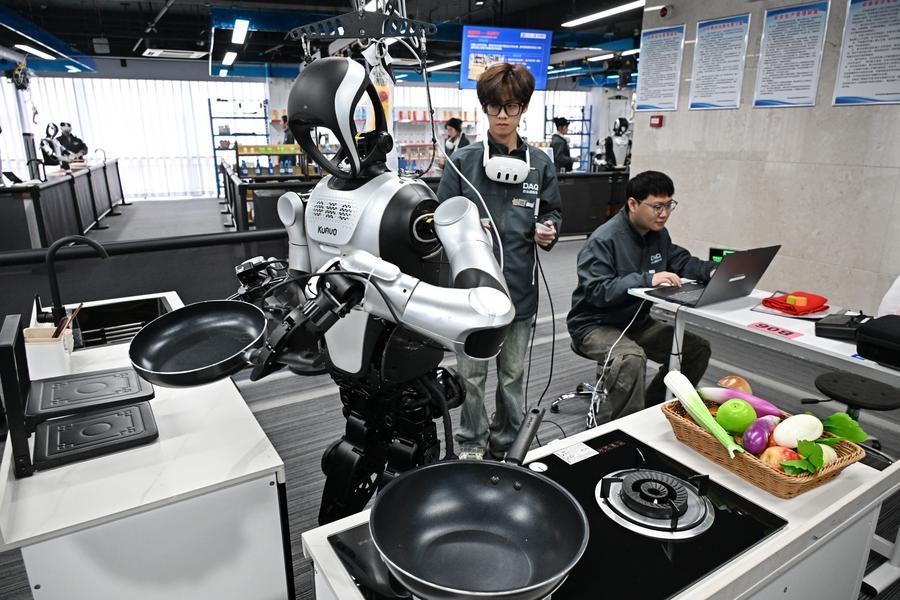
It is evident that technology is reshaping consumption and business models, leading new supply with new demand and creating new demand with new supply. With technological innovation and higher efficiency, costs are also being lowered, which benefits numerous consumers.
Tech self-reliance is imperative, not only for China, but for all other countries, especially in the face of global supply chain disruptions and geopolitical instability. As the world’s second-largest economy, China’s innovation-driven growth will not only sustain its long-term development, but also create more opportunities for global development.
China’s tech self-reliance strategy does not mean that it will “systematically favor enterprises over households.”
The word “consumption” appears 33 times in this year’s government work report, and “building a robust domestic market” tops the major tasks for 2026, as China ramps up efforts to spur consumption, a key pillar of domestic demand, through various measures and special initiatives.
Official data shows that China’s total retail sales of consumer goods surpassed 50 trillion yuan last year for the first time, up 3.7% year on year, while consumption contributed 52% to economic growth, up 5 percentage points. The country also plans to realize a notable increase in household consumption as a share of GDP over the next five years.
Spending potential in culture, tourism, sports and other service sectors has also been unlocked to a remarkable level as China’s consumption upgrade trajectory is shifting from basic goods to higher quality, smart and experience-based products and services. Data from the Ministry of Culture and Tourism shows that domestic tourist trips surpassed 6.5 billion in 2025, up over 16% year on year, while spending hit a record high of 6.3 trillion yuan, a 9.5% increase.
From 2024 to 2025, the consumer goods trade-in programs drove 3.92 trillion yuan in total sales, benefiting 494 million purchases, according to Ministry of Commerce statistics.
This year, to promote the expansion and upgrading of goods consumption, the country will earmark 250 billion yuan in ultra-long special treasury bonds for trade-in programs, set up a special fiscal-financial coordination fund of 100 billion yuan to facilitate domestic demand expansion, and broaden the coverage of loan interest subsidies for consumers and service entities.
The government work report also highlighted that an income growth plan for urban and rural residents will be formulated to enhance residents’ willingness and ability to spend. A range of practical measures will be unveiled to boost the earnings of low-income groups, increase property incomes, and refine the remuneration and social security systems.
It is time for certain Western voices to stop the “either/or” binary thinking that willfully pits China’s industrial upgrading against household consumption and overall welfare. It is clear that China is on track for more balanced, coordinated and sustainable development, and never plans to promote industrial advancement at the expense of consumption.