China is Winning the Humanoid Robotics Race, and It’s Not Even Close
 Facebook
 Twitter
 Linkedin
 Google +
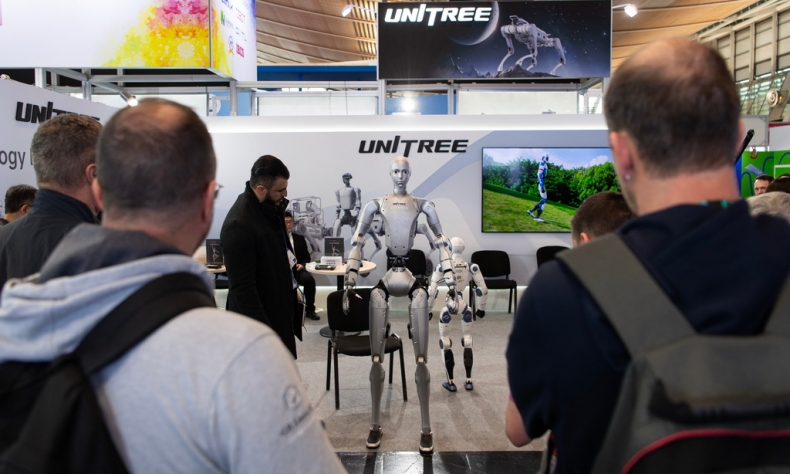
The robots doing real work in real warehouses for real customers overwhelmingly say ‘Made in China’ on the box.
This month, BYD, the world’s largest EV manufacturer, will roll out a new humanoid robot in its showrooms, where it will greet visitors and answer questions. It’s a small debut, but it is part of a much bigger story: China now builds more humanoid robots than the rest of the world combined, and at a fraction of the price.
Last year, Chinese manufacturers accounted for roughly 85 percent of all humanoid robots shipped globally. Of the more than 13,000 units that left factories in 2025, Unitree and AGIBOT accounted for 10,000. Their American counterparts, Figure AI and Tesla, shipped fewer than a hundred. Boston Dynamics, the best-known American robotics brand, only began commercial shipments of its Atlas humanoid in 2026, and every unit built this year is already slated for Hyundai and Google DeepMind, with no open market sales expected before 2027.
The price gap tells the real story
Walk through the numbers, and the imbalance is hard to miss. Unitree’s G1 humanoid has been available to buy since 2024 and is currently listed between $13,500 and $18,000. Its smaller sibling, the R1 Air, starts at just $4,900. These are not demo units restricted to trade shows. They ship with a software development kit, work with standard robotics frameworks, and have built an active developer community around them. Tesla’s Optimus, by comparison, is still not available for purchase as of mid-2026. Elon Musk has suggested a $20,000 to $30,000 price tag once it does ship, but that number remains a projection.
That distinction matters. A robot stuck in a factory pilot program can’t be stress-tested by thousands of independent buyers, but one selling in the tens of thousands for universities, research labs, and companies worldwide can have its flaws found and fixed in public, fast. China’s robots aren’t necessarily more durable by design. They’re more durable in practice, because they’ve already survived contact with far more real users.
Unitree is not the only name doing this at scale. AGIBOT has matched its shipment numbers unit for unit. UBTech, listed on the Hong Kong stock exchange, is targeting 5,000 humanoid robots produced this year and 10,000 the year after. Xpeng, better known outside China for its EVs, has moved its Iron humanoid into production, aiming for over 1,000 units a month by the end of 2026, starting as sales assistants in showrooms before rolling out in factories.
What’s telling isn’t any single company’s roadmap. It’s that carmakers, drone makers, and AI labs alike are converging on similar production targets at the same time. This kind of momentum requires progressive real supply chains and a dedicated policy environment to pull off, not just ambition.
Why China got here first
Four things explain the gap, and none are a mystery. The first is the complete and all-inclusive supply chain. China processes roughly 90% of the world’s rare earth elements, the materials that go directly into a robot’s motors and joints, giving it direct access to something the rest of the world does not have. The Yangtze River Delta and the Greater Bay Area in Guangdong are industrial powerhouses, home to suppliers, robot assemblers, AI labs, and EV manufacturers. No other region on earth has that density. A part that needs redesigning does not sit in a shipping container for six weeks; it gets fixed a half hour away. China’s manufacturing clusters see prototype turnaround measured in days to weeks, compared to weeks or months in the US or Germany, and that speed compounds quickly in an industry still working out basic questions of form and function.
The second is talent. China now graduates roughly 3.5 million STEM students every year and produces more STEM PhDs annually than the United States. Chinese universities also work directly with robotics firms in a tight feedback loop, sending engineering graduates straight into companies like UBTech and Unitree. Manufacturing capacity means nothing without enough engineers to design what gets built on it, and China currently produces that pipeline at a scale no other country can match.
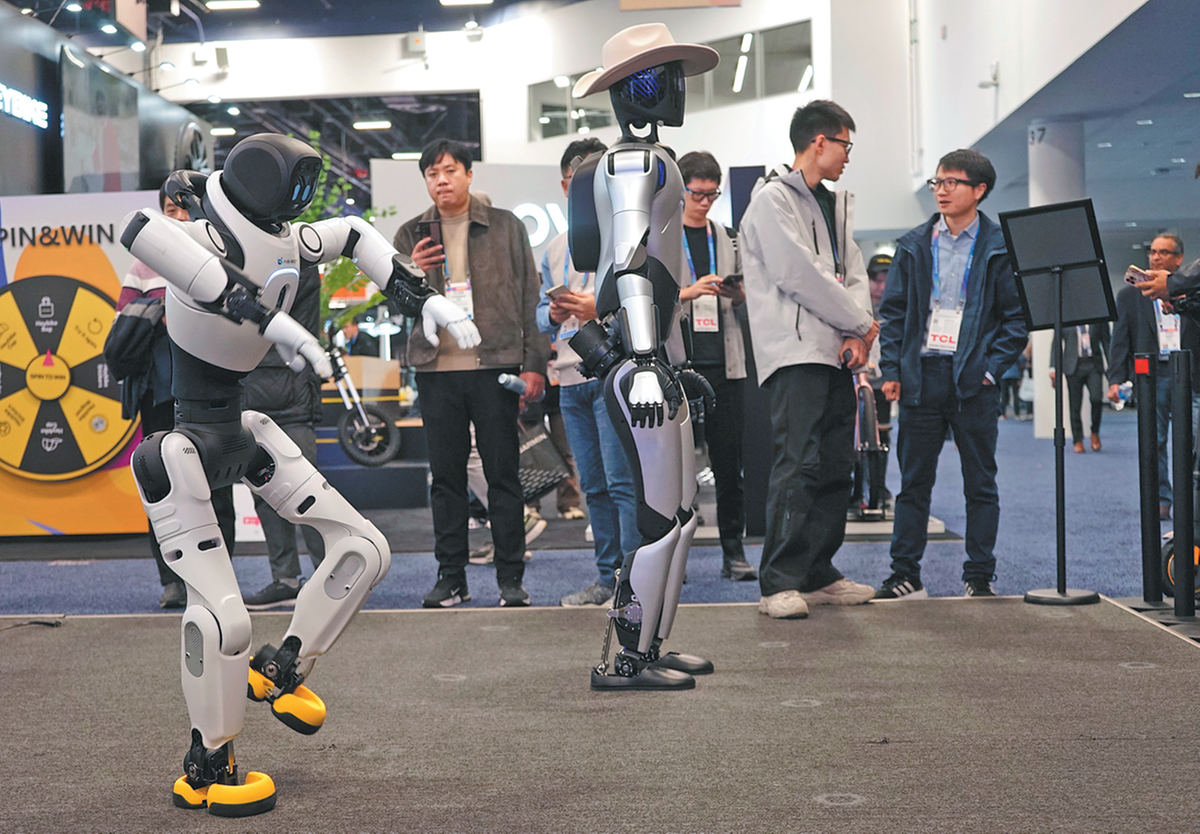
The third is government backing, and this is the piece Western coverage tends to either overstate or ignore entirely. China’s humanoid robot output is expected to exceed 100,000 units this year, according to the Ministry of Industry and Information Technology. UBTech’s own chief branding officer has said the company expects manufacturing costs to fall 20 to 30 percent annually as China’s supply chain shifts further toward humanoid robotics. This isn’t one company making a bet. It’s a government vision to place robotics as a strategic industry and backing that decision with investment, land, and procurement contracts at the local level.
The fourth is that the innovation lead isn’t just a manufacturing story anymore; it shows up in the patents themselves. Legal research firm LexisNexis released a ranking last month scoring humanoid robotics startups on patent volume, technological value, and global market coverage. Chinese firms swept the top five spots and six of the top ten overall, with Unitree at the top. Only three American companies made the cut, plus one German firm. Over the past decade, patent filings from Chinese inventors have doubled in the systems that let robots interact with their surroundings, grown two and a half times in physical body design, and jumped fivefold in the software that controls and plans a robot’s movements. This isn’t imitation. It’s where the underlying research itself is happening.
The software gap is closing faster than people think
The one argument still made against China is software. For years, the theory was that China would win hardware but American labs, like well-funded Physical Intelligence, would keep the “brains”: the models that tell a humanoid what to do with what it sees.
That theory just failed its first real test. RoboChallenge, an independent platform that scores AI models on physical tasks using actual robot hardware rather than simulation, has been topped by a Chinese open-source model since January 2026. Spirit AI, a Hangzhou startup, took the top spot, beating Physical Intelligence outright, then open-sourced the model weights, training data, and evaluation code so anyone could verify the result. In June, its successor model topped a second major leaderboard, RoboArena, co-developed by Nvidia with Stanford and Berkeley, edging out Nvidia’s own Cosmos model in the process. As of this writing, no American model holds the top spot on either board.
The reason this happened so fast is the same reason China leads on hardware. These models can’t be trained on the internet the way a chatbot can; they need real sensor data from real robots performing real tasks, and that data doesn’t exist until someone builds enough robots to generate it. China’s factories are generating the training data that makes the next generation smarter. Hardware and software were never two separate races. China built the lead on one and is now using it to win the other.
Where this leaves the future of robotics
BYD’s showroom robot will not change any of this on its own. What it represents is the normal pace of a country that has decided robotics belongs on factory floors, in showrooms, and eventually in homes, faster and cheaper than anywhere else.
RBC Capital Markets estimates the global humanoid robot market could reach $9 trillion by 2050, with China capturing more than 60 percent of it. Every part of this industry, whether it be the factories, the price points, or now the AI models running the robots, points in the same direction. No other country is positioned to change that trajectory anytime soon. The robots doing real work in real warehouses for real customers overwhelmingly say “Made in China” on the box. That is not a prediction. It is already the count, and there is no sign of it slowing down.