Chinese Elements at the 2026 World Cup
 Facebook
 Twitter
 Linkedin
 Google +
China’s contribution to the event is no longer just about what fans wear or wave, but what they see and connect with emotionally on one of the world’s biggest stages.
On June 11, when the opening whistle blew inside Mexico City’s Estadio Azteca, global soccer officially entered World Cup season. Co-hosted by the United States, Canada and Mexico, this expanded 48-team tournament from June 12 to July 20 is the largest and most geographically expansive edition in the competition’s history.
For Chinese fans, a familiar reality lingers: The Chinese team has once again failed to qualify, an absence that has persisted since its sole appearance in 2002. Yet another equally familiar story is unfolding: Chinese elements are embedding themselves deeper, more broadly and more substantively into the fabric of this global sporting spectacle.
Where tech meets the game
The 2026 International Federation of Association Football (FIFA) World Cup is a breakthrough moment for Chinese technology in core on-field systems.
Chinese appliance giant Hisense is the tournament’s official Video Assistant Referee (VAR) technology partner, a role that is critical to match fairness. The company has deployed its self-developed display equipment inside the VAR operations room. The system demands ultra-high definition, ultra-low latency and precise color reproduction, and Hisense’s involvement ends the longstanding monopoly held by established Western brands over the core technology of top-tier international events.
Alongside Hisense is Lenovo, an official technology partner. Lenovo has deployed over 17,000 servers and workstations, reducing live broadcast latency to under five seconds. The company also provides other solutions, including an AI-enhanced video system to show audiences the referees’ perspective, offering indispensable AI computing power for the tournament.
Even the “star” of the pitch, the official match ball called the Trionda, bears a distinct Chinese imprint. Its name loosely translates as “three waves” and symbolizes the unity of the three host nations. The ball features a built-in smart bladder equipped with a 500Hz chip that records 500 touch-data points per second. It works alongside body-tracking technology to assist referees in making decisions. This smart bladder was developed in China, manufactured by a company in Huai’an, Jiangsu Province, dedicated to the research, development and production of sports ball linings.
Manufacturing and cultural armada
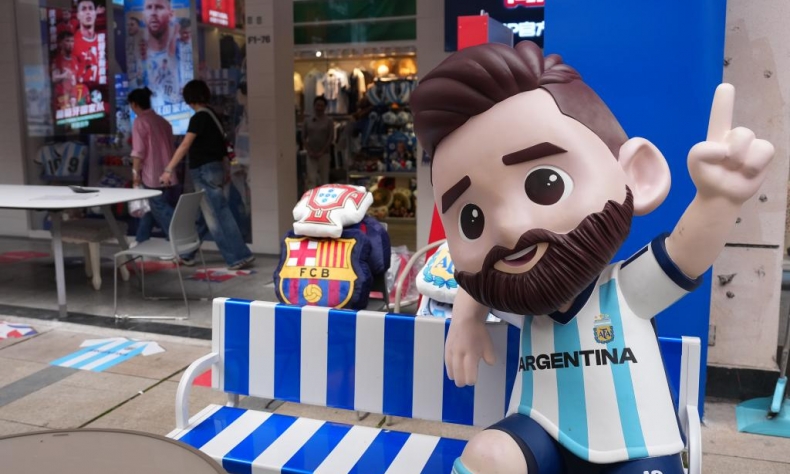
Walk into the sports equipment section of Yiwu International Trade City, the world’s largest wholesale market for consumer goods, in Yiwu, Zhejiang Province, and the World Cup vibe is everywhere. Since last year, buyers from around the world have been roaming the aisles, shopping lists in hand, haggling with vendors. Yiwu is the world’s “super factory” for sports merchandise and produces approximately 70 percent of all World Cup-themed products, earning it the titles of “the ultimate World Cup mood maker” and the tournament’s “invisible champion.” Producing soccer balls, jerseys, horns, inflatable sticks, mini flags, team-themed glasses, hats, wigs and even nail art, thermoses and much more, the city has just about every piece of fan gear covered.
Wen Congjian has been in the sports apparel manufacturing and export business for nearly 20 years. He’s supplied goods for five consecutive World Cup tournaments and is an officially licensed jersey supplier for FIFA. In an interview with newspaper Global Times, Wen said Yiwu merchants kicked into “World Cup mode” a full year before the tournament even began. He started stocking up, producing and taking orders back in June last year, with order volumes climbing month by month and peaking in January. By March, most orders had already been shipped and delivered.
Wen said thanks to the World Cup effect, factory orders have jumped two to three times above normal levels since June 2025, arriving from more than 50 countries and regions. “Canada and Mexico have placed especially large orders this year, Mexico in particular,” he noted. Buyers from Latin American countries like Brazil, Argentina, Panama and Colombia have also kept overall demand steady.
According to Yiwu Customs statistics, the city’s exports of sports goods and equipment exceeded 11 billion yuan ($1.62 billion) in 2025, up more than 20 percent year on year. In the first two months of this year alone, exports had already surpassed 2.34 billion yuan ($346 million), a year-on-year surge of 38.5 percent. Exports to the U.S., Canada and Mexico totaled 550 million yuan ($81 million), an increase of over 21 percent year on year.
Tian Xuan, Dean of Peking University’s Guanghua School of Management, said China boasts the world’s most complete manufacturing system, covering everything from raw material supply and parts production to final assembly and cross-border logistics. Even if overseas demand comes in early and orders pile up all at once, the country’s industrial clusters can work together to absorb the pressure and ensure timely deliveries. This “flexible production plus cluster collaboration” model is what makes China’s supply chain irreplaceable in the global market, he added.
While Yiwu occupies the mass market sector of World Cup merchandise, Dongguan, a major manufacturing city in Guangdong Province, has moved up the value chain.
Dongguan Wagon International Co. Ltd. first crossed paths with the World Cup in 1994 as an ordinary contract manufacturer. Thirty-two years later, it has become the sole global top-tier licensed producer of the FIFA World Cup Trophy for 2026.
This year, Wagon secured authorization to produce a 26-cm trophy replica. Limited to 2,026 pieces worldwide, each bears a unique serial number.
Production is intricate. A single trophy takes three months and involves over 10 processes, with polishing, coloring and assembly done by hand.
The upgrade from zinc alloy to pure copper, while enhancing the texture, brought with it a host of challenges: Microscopic pores form during casting, and acid seepage can cause oxidation. Wagon brought in jewelry-finishing factories for precision work. The company revealed that about two thirds of castings had to be redone. This attention to detail has propelled revenue from $12 million in 2022 to a projected $40 million for this tournament.
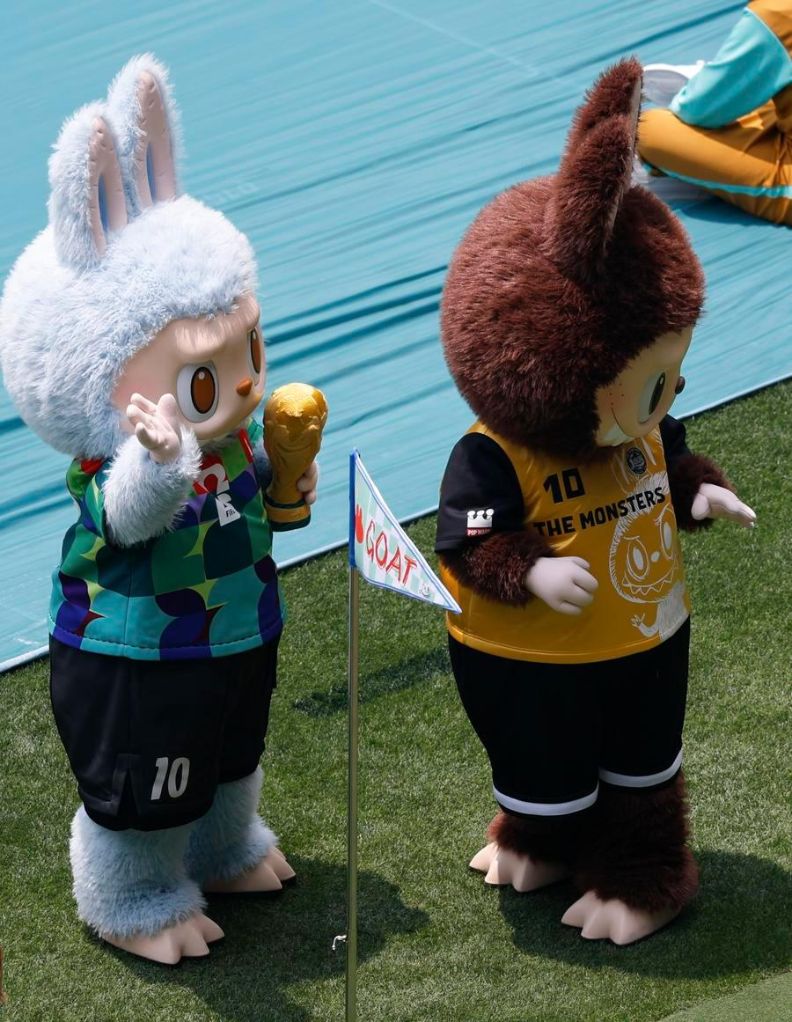
Alongside physical goods, Chinese cultural intellectual property (IP) made its World Cup debut at the opening ceremony. Labubu, the best-known character from Chinese pop culture brand Pop Mart, took to the stage, becoming the first Chinese original IP to participate in a FIFA World Cup opening celebration.
Recognizable by its nine teeth and upright pointed ears, Labubu is a key member of The Monsters, a group of elf-like creatures. Since its debut in 2015, the character has evolved from a designer toy into one of China’s most recognizable cultural brands on the global stage.
FIFA was drawn to its strong appeal among young audiences worldwide, a sign that Chinese IP is steadily integrating into global culture. Pop Mart took the opportunity to launch co-branded products during the tournament, and Labubu appeared in the official music video for the event’s theme song in May, the first time a designer toy brand has been featured in an official FIFA World Cup music video.
These milestones represent a new frontier for Chinese elements at the World Cup. China’s contribution to the event is no longer just about what fans wear or wave, but what they see and connect with emotionally on one of the world’s biggest stages.